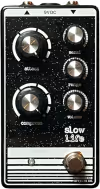
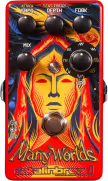
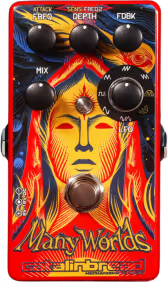
I was pleasantly surprised when I first plugged into the Many Worlds. Just on a “vanilla” sine LFO, I could already hear Red Hot Chili Peppers vibes from the By the Way era. It’s an eight-stage phaser with eight selectable phase control parameters: six LFO waveforms and two envelope-dependent phase shift modes. Psychedelic, watery, lush, funky, it’s all in this box.
Controls
Reading the panel left to right across the top row: FREQ, DEPTH, FEEDBACK. Bottom row: MIX, then the WAVEFORMS rotary. FREQ sets the LFO speed (or, in envelope modes, the attack filter cutoff). DEPTH controls the sweep amplitude (it becomes a second LFO frequency in Battle Mode). FEEDBACK adds internal resonance, and turning it up makes the phaser sound more intense and drippy. MIX balances wet and dry signal.
The WAVEFORMS rotary is the real personality switch. Its eight positions cover sine, square, triangle, sawtooth, reverse sawtooth, envelope up, envelope down, and battle mode. Due to the secondary functions of the knobs across several modes, the Many Worlds has a learning curve. In the demo above I’ve set up sweeps for the Depth and Feedback knobs plus a Battle Frequency Sweep, so you can hear how each one reshapes the effect without toggling through modes yourself.
How It Sounds
The eight presets in the demo map each waveform position. Deep Sine Phaser (freq: 7, depth: 8, feedback: 7, mix: 10, sine) is the classic starting point: warm and enveloping, exactly the RHCP-adjacent tone that first drew me in. Lush Triangle (freq: 2, depth: 10, feedback: 8, mix: 5, triangle) slows everything down and opens the depth fully for a wide, dripping sweep. Blinking Square (freq: 8, depth: 4, feedback: 4, mix: 5, square) gives you a choppier, more rhythmic pulse.
The envelope modes are where things get funky. Honky Auto-wah (waveforms: envelope up) turns your picking attack into the phaser trigger, with FREQ now controlling the low-pass filter in the envelope detection and DEPTH setting the sensitivity. Smooth Auto-wah (waveforms: envelope down) inverts that motion for a softer, more liquid response. Both have a sweet spot for SENS that varies with your guitar and signal chain.
In Battle Mode, two LFOs modulate each other. The FREQ knob controls the first LFO and DEPTH controls the second. Set one frequency low and one high and you get a rhythmic fading in and out of fast phasing. Set them close together and the phasing becomes warbly and unpredictable, as in the Battling LFOs preset (freq: 4, depth: 8, feedback: 5, mix: 5). The Fake Delay preset (waveforms: sawtooth, freq: 8) shows how far you can push the phaser away from conventional territory.
Many Worlds vs Fundamental Phaser
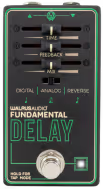
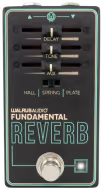
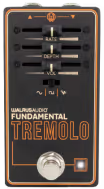
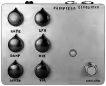
The Walrus Audio Fundamental Phaser is the other phaser in this demo collection and a reasonable cross-reference. The Fundamental is a digital three-mode pedal (Light, Medium, Heavy) with Rate, Depth, and Feedback sliders: approachable, compact, and consistent across modes. The Many Worlds covers some of that same ground (both have feedback resonance and depth controls) but adds six distinct LFO waveforms and two envelope modes, which means the Many Worlds’ character shifts substantially from position to position on the rotary. Where the Fundamental stays predictable across its three modes, the Many Worlds’ envelope and battle positions behave like different pedals entirely. The trade-off is complexity: the Fundamental is quick to dial in, and the Many Worlds rewards patience and experimentation.
Who It’s For
This pedal suits players who want a modulation tool that covers serious range, from subtle swirl to auto-wah funk to unpredictable LFO chaos. It works well as a recording pedal where you can take time to explore the modes, and the envelope settings are particularly good for adding percussive movement to clean or lightly driven tones. The honest caveat: if you want one dialed-in phaser sound that’s always ready to go, the learning curve and the mode-dependent knob behavior may feel like more than you want to manage live. For anyone willing to dig in, the Many Worlds delivers sounds you won’t find on a simpler phaser.