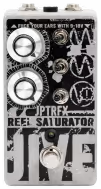
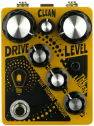
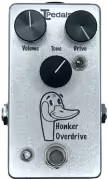
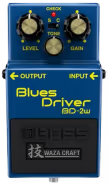
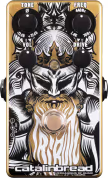
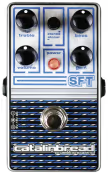
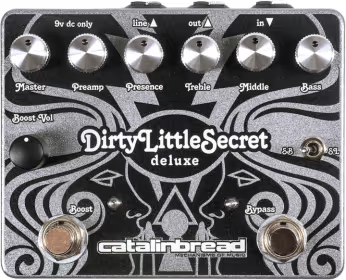
Most overdrives come with an opinion about your tone. They cut bass before the clip stage, bump a mid frequency after it, or both, and the result is their character layered on top of yours. The Catalinbread Tribute works differently. It pairs a high-headroom drive circuit with a one-band parametric EQ derived from Catalinbread’s earlier VariOboost design, so you pick which frequency gets shaped and by how much.
The drive is amp-like in a specific sense: it feels like your amp starting to break up rather than a pedal imposing its own voice. Same basic tone, just grittier.
Controls
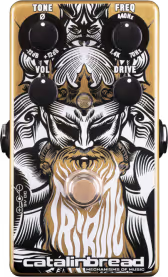
The panel reads left to right, top then bottom. Top row: Tone on the left, Freq on the right. Bottom row: Vol on the left, Drive on the right.
Tone and Freq work together as the parametric EQ. Freq sweeps the center frequency from 70 Hz to 1.4 kHz; Tone boosts or cuts that band by up to 12 dB. At noon, Tone is flat, and there’s a center detent that clicks into position at zero cut/boost so you always know when you’re neutral. Drive is a dual-gang pot managing the clean blend and overdrive gain simultaneously. Vol sets the output level independently.
In the demo above I’ve set up sweeps for the Freq, Tone and Drive knobs, so you can hear exactly what each one does.
How It Sounds
The gain range runs from light touch through medium breakup. Sweet Spot (tone at 8, freq at 6, vol at 6, drive at 10) shows how far the circuit will push: present, forward and grinding without losing definition. Low Cut (tone at 2, freq at 9, vol at 8, drive at 10) dials in a cut high in the midrange for tightening up a muddy signal. Upper Mid Boost (tone at 8, freq at 3, vol at 8, drive at 7) does the opposite, lifting the upper mids for note definition and chordal sparkle. Mid Scoop (tone at 0, freq at 2, vol at 8, drive at 8) cuts the low-mids hard, creating space in a mix without touching the lows or highs directly.
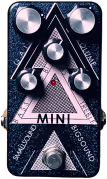
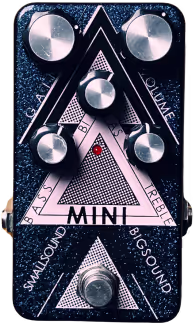
The Tribute stacks well in both directions. Running it before the Smallsound/Bigsound Mini (preset: Mid Boost into SS/BS Mini, tribute tone at 10, freq at 5, drive at 5) slams the Mini’s front end, producing a thick, almost fuzzy rhythm sound that neither pedal hits alone. Stacking it after the Vaderin HP-X (preset: Stacked after Vaderin HP-X, tribute tone at 2, freq at 1, drive at 8) lets you shave high-end edge off the HP-X and pile on more gain texture. The noise floor stayed impressively quiet throughout.
Tribute vs Timmy
The MXR Timmy is the other EQ-forward transparent overdrive worth comparing here. Both aim to leave your amp’s character intact rather than color it, but their EQ approaches are opposite. The Timmy’s Bass and Treble controls are cut-only shelf filters: you remove what you don’t want. The Tribute’s single parametric band boosts or cuts, and you choose the frequency it targets. If you know exactly what your tone is missing or has too much of, the Tribute is more surgical. If you’d rather trim the extremes without worrying about frequency selection, the Timmy is simpler. The Tribute also works on bass: a focused boost at 80-90 Hz does real work on a bass signal, which the Timmy isn’t designed for.
Who It’s For
Players who record or play with multiple instruments get the most out of the Tribute’s flexible EQ: guitar players can bump mids to cut through a mix, shave low-mids to clean up a neck pickup, or boost presence for chord definition. Bass players can add low-end weight without affecting the rest of the signal. The honest caveat is the gain ceiling: this tops out at medium breakup, so for heavier saturation you’ll want something stacked in front of it. If you want an overdrive that shapes to your rig rather than imposing on it, this earns its spot on the board.
Specs
Circuit: all-analog high-headroom drive with one-band parametric EQ, derived from the Catalinbread VariOboost
Controls: Tone (±12 dB boost/cut, center-detent at noon), Freq (70 Hz to 1.4 kHz), Vol, Drive (dual-gang, clean blend and overdrive gain)
Works with guitar and bass
Power: 9 V DC center negative, minimum 50 mA
Dimensions: 4.33 x 2.36 x 1.96 inches (110 x 60 x 50 mm), 0.4 lbs (227 g)
Signal Chain
I tried adding a bunch more guitar overdubs, but ultimately found that this minimalistic track with only guitar, bass and drums does it for me.
Main Guitars
Epiphone SG Special with Lollar Firebird pickups (neck pickup)
I used the same guitar and settings for the left and right channel and panned them just 25% to get a more focused, punchy sound (in contrast to a “wide” sound where I would hard pan two slightly different sounds).
Bass
JMJ Mustang*, Fender flatwound strings, tone 100% up, played with a pick.
Tribute with a 12dB boost at ~80-90Hz and drive slightly past noon
Iridium on the round setting with SVT cabs, as demoed here
I really liked the tribute as a bass overdrive. There was very little EQing I had to do in the DAW.
Drums
GarageBand drummer Zak (garage rock) on the Brooklyn kit
As usual, everything went into the Focusrite Scarlett 2i2 and was mixed in GarageBand with a mild combination of compression, limiter and exciter on the master track to bring everything to life.