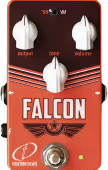
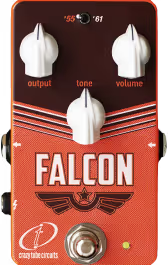
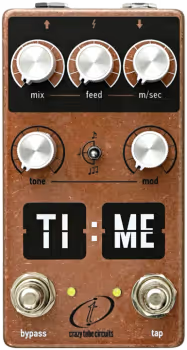
The Falcon by Crazy Tube Circuits is really two amps in one pedal. It emulates a 5E3 Tweed Deluxe from ’55 and a 6G2 Brownface Princeton from ’61, and Crazy Tube Circuits built it by copying the behavior of the preamp, phase inverter and power amp of both designs with JFETs, rather than just approximating their tone.
The feel sells it more than any single sound does. The sag and compression, especially in ’61 mode, make it feel genuinely amp-like, and it responds very dynamically to pick attack and guitar volume the way an actual tube amp would.
Controls
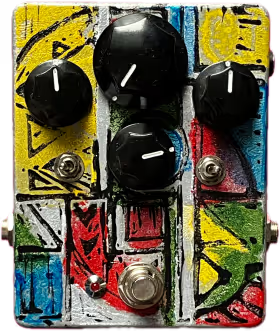
Reading the panel left to right: Output sits on the left, the ’55/’61 mode toggle sits centered above between the knobs, Volume is on the right, and Tone sits below, centered under the toggle. The bypass stomp switch and status LED are at the bottom.
The labels can be misleading. Volume is practically a gain or drive knob here, basically what you’d get if you turned up an actual amp of that era. Output is the one that actually controls the volume coming out of the pedal. The Tone knob works like the tone control on these amps: roll it back below noon to smooth off the highs, or push it past noon to boost the upper frequencies and add a touch of extra gain and bite. Crazy Tube Circuits notes it interacts with Volume too, its effect getting more subtle the higher you push the Volume knob.
In the demo above I’ve set up sweeps for Tone, for the mode toggle itself via the ’55 vs. ’61 preset, and for Volume in both modes with the Princeton Gain Sweep and Tweed Gain Sweep, so you can hear exactly what each control and each amp voicing does to the same riff.
How It Sounds
’55 mode carries more gain and low end than ’61, along with noticeably more sag, emulating the Tweed Deluxe’s cathode-biased power section. Crunchy Tweed (Volume 8, Tone 5) sits right in that breakup zone, while Light Tweed (Volume 4, Tone 7) backs off into a cleaner, brighter version of the same voice.
Flip to ’61 mode and the Princeton’s fixed-bias power section tightens everything up: less gain, tighter low end, and a cleaner ceiling even with Volume maxed. The Princeton Gain Sweep and Tweed Gain Sweep presets walk Volume from 0 to 10 in each mode with Tone parked at 7, and the gap is obvious: the ’55 side starts breaking up well before the ’61 side does. Even with ’55 gain maxed out, you won’t get real high-gain sounds. I think that’s a tasteful design choice, since that’s not what these amps were built for.
The range and taper on all three knobs is well judged too. Pretty much the whole sweep on each one gives a useful sound, without much wasted at the extremes.
Falcon vs SFT
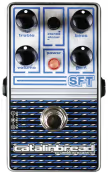
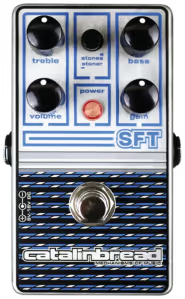
The SFT is the other JFET amp-in-a-box on the site, and the natural cross-shop. Where the Falcon chases Fender’s tweed and brownface era, the SFT is built around Ampeg’s circuit, with a Baxandall tone stack that actively boosts or cuts highs and lows past noon rather than just rolling them off. The SFT’s stones and stoner modes shift the available headroom on a single voicing; the Falcon’s ’55 and ’61 modes swap between two distinct amp designs, complete with different bias behavior and sag character.
Both pedals lean on JFETs for that amp-like feel and both clean up when you back off your guitar volume. If you want Ampeg low-end weight and an EQ you can actively sculpt, the SFT is the one. If you want the push and pull between a saggy tweed breakup and a tighter brownface clean, the Falcon is built for exactly that.
Roots, Americana and blues players chasing vintage Fender breakup will find this an easy sell, and it stacks well with other pedals in front of it since neither amp voicing has all that much gain on tap. Volume-knob players get real mileage out of it too, since the JFET circuit cleans up naturally as you back off.
If you’re after high-gain distortion, look elsewhere. The Falcon is tuned for touch and breakup rather than saturation, and even ’55 mode maxed out stays in vintage-amp territory rather than pushing into modern gain.
I think this could be a main sound for a lot of players for a good while.
Specs
Circuit: JFET emulation of the preamp, phase inverter and power amp of a 5E3 Tweed Deluxe (’55) and 6G2 Brownface Princeton (’61)