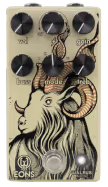
The Eras is Walrus Audio’s flagship distortion: a five-state pedal built around a clean blend knob and five distinct clipping configurations, covering everything from compressed silicon crunch to tight LED bite. It’s a utility box for all your distortion needs.
With the different clipping options, a wide range for bass, tone and gain, and some mighty output volume, the Eras can fit into any mix that requires a distorted guitar (or bass).
Controls
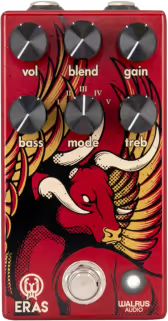
The six controls split across two rows. Top row, left to right: Vol, Blend, Gain. Bottom row: Bass, the five-position Mode rotary, Treble. Bass and Treble both work as boost/cut controls, which gives you genuine two-way shaping rather than just a tone bleed. Blend is the standout: it mixes your clean signal back in with the distortion, so you can preserve pick attack and low-end definition even at high gain settings.
The Mode rotary is the heart of the pedal. Each position combines a mid-cut depth (slight or deeper) with a specific diode configuration: Mode 1 uses LED clipping with a slight mid-cut for the fastest response, great for palm muting. Mode 2 is silicon with a slight mid-cut, smooth with added compression. Mode 3 combines silicon and LED diodes with a slight mid-cut for a rich, full voice with added sustain. Mode 4 goes to a deeper mid-cut with LED clipping for scooped, tight rhythm tones. Mode 5 is deeper mid-cut with silicon diodes, rhythmic, warm and full.
In the demo above I’ve set up sweeps for the Blend knob (running through Mode 3), the Gain knob (in Mode 4), and a full Clipping Modes sweep so you can hear all five states back to back.
How It Sounds
Something you can’t quite get from demos is the feel and response of the pedal. Every one of the five states was very different in how it felt under the fingers. I like how all modes are distinctively different and yet all are useful for certain applications. Depending on the state, the Eras made me want to play lead, desert rock riffs, some amateurish chugging or play noisy open-string chords.
The three static presets map some of that range. Chimey Drive uses Mode 2 (silicon, slight mid-cut) with Gain at 3, Blend at 5 and Treble at 8: the silicon clipping with moderate gain gives a compressed, chimey overdrive voice. Fat Distortion pushes Mode 5 (silicon, deeper mid-cut) with Gain at 7 and Blend fully wet at 10 for a warm, full wall of distortion. Tight Rhythm selects Mode 4 (LED, deeper mid-cut) with Gain at 7 and Blend at 8: that LED clipping and scooped mid character make it punchy and precise for chugging. If you don’t find a sound you like with this pedal, I guess you’re more into jazz.
Eras vs Fundamental Distortion
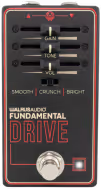
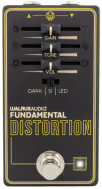
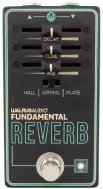
The Fundamental Distortion is Walrus’s RAT-style budget distortion with three clipping modes (DARK, SI, LED) and a slider-format panel. It’s a focused, single-circuit pedal with a post-distortion tone control and no clean blend. The Eras is a different proposition entirely: five clipping configurations rather than three, a dedicated Bass control alongside Treble, and the Blend knob that the Fundamental Distortion doesn’t have. The Eras can run partly wet, which opens up stacking and parallel-blend tricks that the Fundamental Distortion doesn’t do. The Fundamental Distortion rewards players who already know they want that RAT voice; the Eras is the right pick if you want a single distortion that covers a wider range of characters, or if the clean blend matters to you.
Who It’s For
This pedal suits players who want a single distortion that can pull off multiple characters without tap-dancing between pedals. The five modes span enough ground that you can reasonably use the Eras as your only dirt pedal in genres from clean-ish overdrive to desert rock to tight metal rhythm. The Blend knob makes it unusually friendly for bass guitar as well, since you can keep the low-end definition intact while adding distortion on top.
The honest caveat: the five-mode rotary is a deliberate choice rather than fast access. If you need to flip between two very different sounds mid-song, you’re twisting a rotary, not flicking a toggle. Players who primarily want one distortion sound dialled in and left alone won’t find that a problem at all.