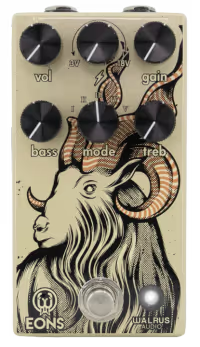
The ACS1 is Walrus Audio’s Mako series answer to the amp-and-cab-in-a-box question, aimed at making home recording and silent stage setups less complicated. If you’re familiar with my recording setup, you know that amp and cab simulation is a topic dear to my heart. I’m on this endless quest to find the best silent setup for not crazy money, and the ACS1 sits comfortably in that conversation.
The sonic range lies between crystal clean and edge of breakup. Three amp models, six IR-based cabinet options, a room reverb knob and a dual-amp stereo mode cover a lot of ground without burying you in menus.
Controls
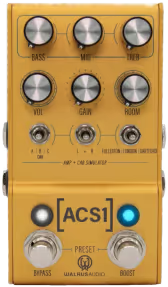
Reading the panel from left to right, top row first: Bass, Mid and Treb handle the EQ. Below them sit Vol, Gain and Room. The Cab toggle on the lower left steps through the three IR pairs; the Amp toggle on the lower right selects the amp model. Positions A, B and C on the cab switch correspond to closed-back cabs by default; hold the bypass switch while flipping it to access the open-back set.
The Boost switch gives you a preset gain and volume jump, useful for solos or switching between a clean rhythm tone and something with more hair. Three onboard presets extend to 128 via MIDI, and you can load custom IRs through walrusaudio.io.
In the demo above I’ve set up a London Gain sweep, a Fullerton Room sweep, and separate sweeps through all six cab options, so you can hear what each IR does to the same riff.
How It Sounds
Each amp model has a distinct personality. The Fullerton, inspired by a Fender Deluxe Reverb, goes from sparkling clean to thumping with the gain up. The London, modeled after a 1962 Marshall Bluesbreaker, has the most gain of the three; with single coils it sits just a touch over edge of breakup with the gain dimed. The Dartford, taking its cues from a 1960s Vox AC30, chimes nicely and gets a little crunchy when pushed. All three are very dynamic and respond well to pick attack.
The Fullerton and Dartford presets sit at gain 7 with room 2, which shows off the clean character before reverb softens anything. The Dartford + London dual preset pushes gain to 10 with room dialed nearly off, which is where the grittier side of the pedal lives.
The Room knob ranges from completely dry to a large studio wash. It’s great for making direct tones feel more three-dimensional, but it’s not a cavernous ambient reverb. For that, their Slö is the one to look at.
ACS1 vs Iridium
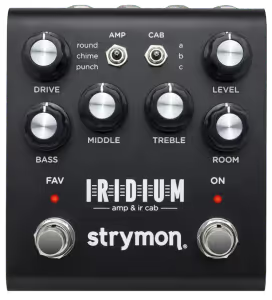
The Strymon Iridium is the obvious point of comparison. Both offer three amp models (Fender, Marshall and Vox), a room reverb, and six cabinet options. The Iridium’s gain stage uses an analog JFET circuit; the ACS1 is fully digital. The Iridium’s Middle knob works differently per model (EQ voicing on the Fender, treble cut on the Vox); the ACS1’s Mid behaves the same across all models. The ACS1 adds dual-amp stereo mode, where different amps run left and right, which the Iridium doesn’t do. The Iridium has a headphone out; the ACS1 does not. Both support custom IRs and MIDI.
Who It’s For
This pedal makes the most sense for players building a rig around direct recording or in-ear monitoring on stage. The clean-to-edge-of-breakup range means it works best as a platform you push with drive pedals, not a high-gain one-stop shop. I especially like combining the boxy, creamy London with the chime of the Dartford in dual-amp mode. It sounds spectacularly good. With the clean settings I instantly had to channel my inner Frusciante through this. I don’t know if it sounds exactly like the original amps it’s inspired by, but it just sounds good, and if it sounds good it is good.