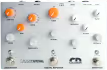
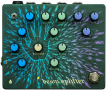
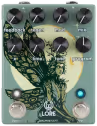
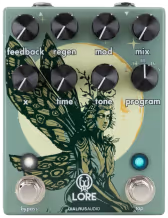
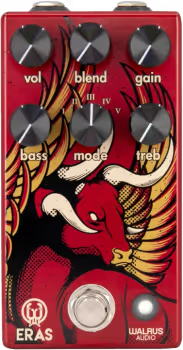
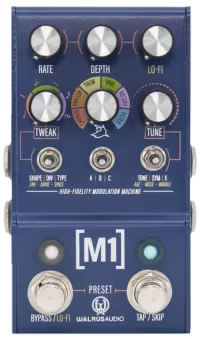
Walrus Audio gave the Lore a bold tag line: Reverse Soundscape Generator. It delivers on that promise. This is not a reverb or delay for subtleties, and it’s not trying to emulate any vintage analog tone. The Lore is for creating ambient textures, something like a mysterious orchestra playing somewhere far in the distance.
Five programs combine reverse delay, reverse reverb, octave-up and octave-down reverbs, and pitch delays into layered, ethereal fields. Two DSP chips run in series, each with its own analog feedback path, interacting organically rather than in predictable lockstep. The result rewards exploration over precision dialing.
Controls
The top row, reading left to right: Feedback, Regen, Mod, and Mix. The second row: X, Time, Tone, and Program rotary. Most controls change meaning per program, which is where the depth lives. Feedback handles delay repeats on Programs I, II, III, and V; on Program IV it controls octave-down amount on the reverse reverb while Regen takes over octave-up amount on the forward reverb. X is the most program-specific: on Program I it controls how reversed the delay is (left barely reversed, right fully reversed); on Programs II, III, and IV it sets reverb decay; on Program V it steps through pitch delay intervals. Time, Mod, and Tone stay consistent across all programs.
In the demo above I’ve set up sweeps for the X knob on Programs I, III, and V and a Feedback sweep on Program III, so you can hear exactly how those controls shift the texture rather than taking my word for it.
How It Sounds
The five named presets map each program’s character. Ominous Delay (Program I) runs Feedback and Regen both at 8 for overlapping reverse washes. Hypnotic Shimmer (Program II) adds breathy octave-up reverb with Mod at 7. Deep Waves (Program III) goes darkest: Regen at 10 and mix at 7 for thick, murky octave-down textures. Dark Ambient (Program IV) puts octave-down and octave-up on separate knobs so you can balance them independently. Dangerous Hope (Program V) runs pitch delay into pitch delay with X at 10, stepping through the full interval sequence.
I’m usually not the biggest fan of secondary functions for knobs. I like to just fiddle and find sounds that inspire me to play. But the Lore handles the complexity well. For an explicit demo I had to look things up in the manual. But it’s easy to not care exactly what each knob does and just play until you land on a soundscape you can’t fully explain.
Lore vs BL-44 Reverse
The BL-44 Reverse by Old Blood Noise Endeavors is the other reverse-effects box on this site. The BL-44 keeps it stripped down: Speed, Clock, Mix, and Volume, with those first two controls highly interactive. You can go from subtle echoes to glitchy lo-fi swells quickly and intuitively. It rewards spontaneous, physical experimentation.
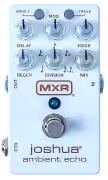
The Lore layers reverse delay, reverse reverb, pitch shifting, and octave coloring into multi-stage signal chains across five programs, and the secondary knob functions mean there’s more to learn. That complexity is the point: the Lore is a dedicated sound exploration tool. If you want lo-fi reverse delay you can grab and go, the BL-44 is the right call. If you want an ambient texture machine that keeps revealing new territory, the Lore is the one. The MXR Joshua page has a separate comparison framing the Lore against a tempo-locked ambient delay.
Who It’s For
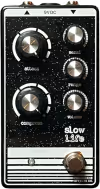
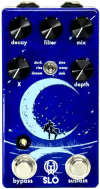
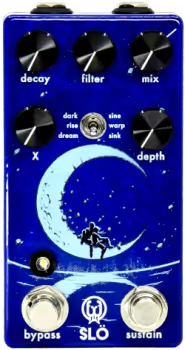
Shoegaze, post-rock, experimental, and drone players will get the most out of this. The honest caveat: secondary knob functions add a learning curve, and this is genuinely not the pedal for subtle ambient touches. If you want modulated reverb with an octave blend and infinite sustain in a more surgical format, the Walrus Audio Slö fits better. The Lore is infinitely tweakable and its purpose is sound exploration. I couldn’t be happier with it. It’s exactly the kind of ambient tool that was missing in my setup.
Specs
Architecture: two DSP chips in series, each with a dedicated analog feedback path
Five programs: reverse delay into reverse reverb; reverse delay into octave up reverb; reverse delay into octave down reverb; reverse reverb into forward reverb; pitch delay into pitch delay
Controls: Feedback, Regen, Mod, Mix, X, Time, Tone, Program (rotary)
Tap tempo via dedicated footswitch; momentary dive/rise by holding tap
Buffered bypass
Power: 9V DC center-negative, 300mA minimum; isolated power supply recommended
Dimensions: 3.62″ x 4.79″ x 2.25″ (including knobs)
Due to the normalization that happens when you export a track in GarageBand, you will notice that some sounds where the mix is higher on the Lore, especially with octave down reverb/delay sounds, the dry signal gets quieter.
For my demos, I export the backing track and the guitar sounds affected by the pedal in the demo separately. In a proper mix, we could have more control over this. We could make the delay/reverb drown out the whole mix for a dramatic effect or turn down the mix to tuck nicely under the mix for a more subtle ambient texture.
Lead Guitar
K’mo Memphis Std., classic T-style pickups (both pickups) and my sloppy tremolo picking which I need to practice more