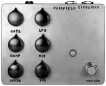
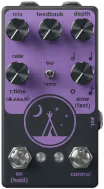
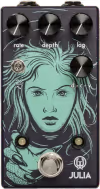
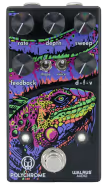
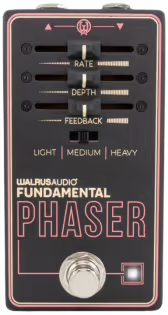
The Walrus Audio Fundamental Phaser is an accessible vibe machine that adds psychedelic movement to your guitar tracks without burying you in menu diving. Classic phasers are often ruthlessly simple, sometimes just a single knob. The Fundamental offers more flexibility while keeping things approachable: three sliders, a three-position mode switch, and a stomp that lets you flip between clean and swirling in a heartbeat.
What makes it genuinely interesting is the Feedback control. Dial it up and the phaser effect gets more pronounced and resonant, tipping toward a flanger-like coloration without actually becoming one. That’s a lot of tonal range for a pedal this straightforward.
Controls
Reading the panel top to bottom: Rate, Depth, Feedback, then the Mode switch. Rate sets the LFO speed, Depth controls how wide the sweep travels, and Feedback determines how much of the affected signal feeds back through the circuit, increasing resonance and intensity. The Mode switch selects one of three phaser algorithms: Light for subtle tonal movement, Medium for a classic warm analog-style emulation, and Heavy for a multi-voiced, more experimental character.
In the demo above I’ve set up sweeps for all four controls so you can hear what each one does in isolation. The Rate sweep covers the full range from a slow, almost imperceptible drift up to a fast choppy throb. The Depth sweep shows how the effect goes from barely there to fully enveloping. The Feedback sweep is particularly useful for hearing how the pedal shifts character as resonance builds. The Mode sweep steps through all three algorithms back to back at the same rate and depth settings.
How It Sounds
The three main presets map out the Fundamental Phaser’s range. Lush Swirl (rate 4, depth 7, feedback 4, mode Heavy) is the lushest setting in the demo: a wide, layered sweep with a bit of harmonic complexity from the Heavy algorithm. Slow Filter (rate 0, depth 8, feedback 5, mode Medium) parks the LFO and lets you hear the filter sitting in place, which is useful as a subtle static coloration rather than a moving effect. Trippy but Subtle (rate 9, depth 2.5, feedback 10, mode Light) is the counterintuitive one: the fast rate and high feedback make the Light algorithm swirl in a more hypnotic, less overtly wobbly way. It earns the “subtle” in the name.
The direct, clean signal chain in this demo, without amp simulation, makes the phaser effect more pronounced than it would be through a driven amp. Worth keeping in mind when you’re dialing in at home.
Fundamental Phaser vs Small Stone
The Electro-Harmonix Small Stone is the classic analog phaser reference point: a simple Rate knob, a Color switch, and that signature warm, organic sweep that’s been on records since the 1970s. The Small Stone’s appeal is exactly its simplicity and its analog character. The Fundamental Phaser is digital, which means the three modes can cover analog-emulation territory (Medium) but also go somewhere the Small Stone can’t (Heavy’s multi-voiced texture). The Fundamental adds Depth and Feedback controls, giving you more ability to shape how intense or subtle the sweep feels. The trade-off is that the Fundamental doesn’t have the Small Stone’s purely analog signal path and the sonic character that comes with it. If you want one knob and that classic vintage sweep, the Small Stone is still the benchmark. If you want algorithm variety and a feedback resonance control in a compact package, the Fundamental covers more ground.
Who It’s For
This pedal suits players who want classic phaser movement without building a complicated rig around it. It works well as an always-on shimmer at low depth and rate settings, or as a more dramatic effect when the feedback gets cranked up. The clean, direct signal chain here particularly suits lo-fi, indie, and ambient playing where the phaser is part of the texture rather than a lead effect. The honest caveat: if you want an analog circuit or a single-knob simplicity, the Fundamental’s digital engine and three controls may feel like more than you need. For anyone who wants to explore phaser territory without committing to a larger multi-mode pedal, it lands in a sensible middle ground.
I recorded the guitar directly into the audio interface without any amp simulation. I used the Keeley Compressor and the MAE Line Blur EQ to shape the tone for this lo-fi hip-hop inspired demo track. I also feel the phaser effect is more pronounced with this direct, clean tone.