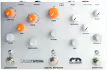
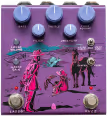
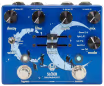
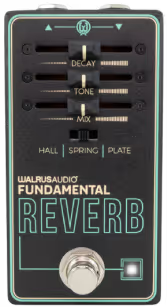
The Walrus Audio Fundamental Reverb makes a strong case for the idea that a reverb pedal doesn’t need to be complicated to be genuinely useful. Three modes, three sliders, and one switch: that’s the whole pedal. What makes it work is that Walrus got the algorithms right and kept the controls honest.
The Fundamental Series is designed to be the best option at its tier for each effect type, and the Reverb earns that brief. If you want a reverb you can set and forget, or one that won’t overwhelm a simple board, this one delivers.
Controls
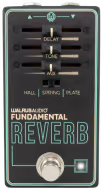
The panel runs top to bottom: Decay, Tone, Mix, then the three-position mode slide switch at the bottom. Decay sets how long the tail rings out. Tone controls the overall brightness of the reverb, rolling from dark and smooth on the left to open and bright on the right. Mix blends the wet signal in from fully dry to fully wet. The mode switch selects the algorithm: Hall in the left position, Spring in the middle, Plate on the right.
In the demo above I’ve set up sweeps for the Decay and Tone sliders and the Mode switch, so you can hear what each does directly. The Decay sweep runs from 0 to 10 with tone at 5 and mix at 7 in Hall mode. The Tone sweep covers 0 to 10 with decay at 8 and mix at 8 in Plate mode. The Mode sweep steps through Hall, Spring, and Plate with decay at 8, mix at 7, and tone at 8.
How It Sounds
The three presets in the demo map the character of each mode. Lush Space (Hall mode, decay 7, tone 6, mix 6) gives you a diffused, spacious wash: long tails that spread out and sit under the playing without crowding it. Springy Room (Spring mode, decay 8, tone 8, mix 7) has that classic amp-reverb bounce: brighter, livelier, with the slight shimmer that makes spring reverb so satisfying on clean tones. Expansive Plate (Plate mode, decay 7, tone 10, mix 6) is denser and more focused: smooth, even decay that works well as a studio-style treatment behind anything from arpeggios to single-note leads.
Trails mode is active by default, so the reverb fades naturally when you bypass the pedal rather than cutting off abruptly. You can toggle it off by holding the bypass switch during power-up.
Fundamental Reverb vs Slö
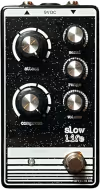
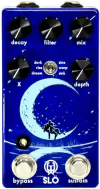
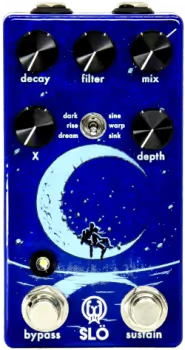
If you’re shopping Walrus reverbs, the Slö is the other obvious option, but the two pedals aren’t really competing for the same player. The Slö is a textural specialist: its Dark mode adds a sub-octave into the reverb, Rise builds an auto-swell so the tail comes in after your attack, and Dream produces a lush latch-capable modulated reverb. It also has a Sustain footswitch and three selectable modulation waveforms. The Slö is built for ambient, post-rock, and atmospheric work where the reverb is a central part of the sound.
The Fundamental Reverb is the opposite brief: hall, plate, and spring are the three spaces you reach for in everyday playing, done well and kept simple. It suits players who want their reverb to support their tone without becoming the whole performance. If you need real-world spaces rather than textural transformations, start here. If you want the pedal to take your signal somewhere else entirely, the Slö is the right call.
Who It’s For
This is a great first reverb, a great board-simplification reverb, and a great secondary reverb for players who already have something ambient and want a practical everyday option alongside it. Spring mode covers country, surf, and classic rock. Hall and Plate work for anything from jazz to post-punk to singer-songwriter. The single-channel, mono-in, mono-out format keeps the signal path clean.
The honest caveat: if you want stereo output, an expression input, or anything beyond hall, spring, and plate, this pedal won’t cover it. It’s designed to do three things well, not ten things adequately.
Specs
Three reverb algorithms: Hall (large diffused space), Spring (amp-style twang), Plate (smooth, dense analog-style)