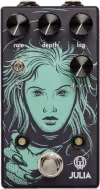
I don’t often use chorus or vibrato. But when I do, I reach for the Walrus Audio Julia. It covers the whole modulation spectrum: a touch of shimmer at one end, fully seasick vibrato at the other, with every shade of chorus in between.
Controls
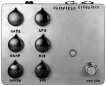
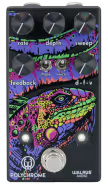
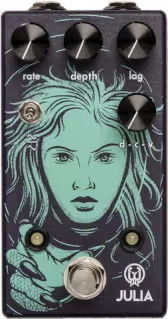
The top row of knobs reads left to right: Rate, Depth, and Lag. Rate sets the LFO speed; Depth controls how wide the modulation swings. Lag is the interesting one: it sets the center delay time the LFO modulates around, so turning it up shifts the effect from tight and transparent toward a thicker, more nauseating detune.
Below Lag sits the D-C-V knob, which is the Julia’s defining feature. At its minimum you’re getting dry signal only with no effect. At noon you get equal dry and modulated signal, which is traditional chorus territory. Push it to maximum and you’re at 100% wet signal, pure vibrato. The waveform toggle switch on the left selects between sine and triangle LFO shapes. In the demo above I’ve set up a sweep for the Lag knob and a waveform sweep (Sine vs Triangle), so you can hear both parameters do their work across different settings.
How It Sounds
The Julia is an all-analog circuit, and the modulation has that warm, slightly rounded quality that comes with it. The Subtle and Lush preset keeps Rate slow at 1 with Depth pushed to 8 and Lag at 6, which gives you gentle movement without any pitch wobble getting in the way. Bubbly Chorus sits with Rate at 6, Depth at 6 and Lag at 7, landing in sparkly shimmer territory. Seasick Vibrato cranks Rate to 6, Depth to 10 and Lag to 8, and shifts the D-C-V well into the wet side at 7 for that rolling, off-kilter pitch wobble. Maximum Vibrato goes all the way: every knob at 10, triangle wave, D-C-V fully wet, which is genuinely unsettling in the best possible way.
Julia vs Fundamental Chorus
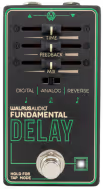
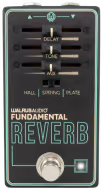
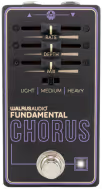
If you’re after straight chorus on a budget, the Fundamental Chorus is Walrus’s entry-level option. It has three chorus voicings (from simple analog warmth to tri-chorus) controlled by sliders, and it does those chorus sounds well. What it doesn’t have is a vibrato mode. The Julia’s D-C-V knob is precisely the thing that sets it apart: you can blend continuously from clean dry signal through full chorus all the way to 100% vibrato, and everything between those poles. If chorus is all you need, the Fundamental handles it cleanly. If you want the option to cross into vibrato territory, or want that continuous blend between the two modes, the Julia is the one to get.
It suits anyone who wants one pedal to cover chorus, vibrato, and every blend between them. The analog circuit works well on clean tones and single-coils, but the bass-compatible design makes it just as useful for bass players chasing slow, warm modulation. The honest caveat: if you only ever use a fixed chorus sound and never stray toward vibrato, the D-C-V control gives you more options than you may actually need.