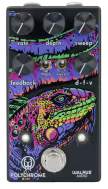
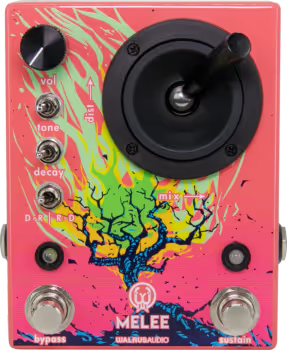
Walrus Audio made what the masses were yearning for: a flanger that doesn’t suck. The Polychrome Flanger is the first flanger that I truly enjoy and find inspiring. When I initially plugged into this, I immediately wanted to play some kind of psychedelic space rock.
A few very smart design choices make this pedal stand out. The D-F-V blend knob, the random waveform option, and the parked filter mode each add something the usual flanger skips over, turning a traditionally one-trick effect into a modulation tool with genuine range.
Controls
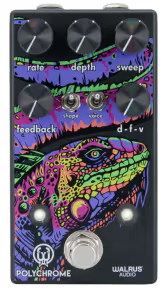
The top row reads Rate, Depth, and Sweep. Rate sets the LFO speed (the blinking LED tracks it). Depth controls the modulation width. Sweep sets the center frequency of the flanger’s notch filter, which shapes where in the frequency range the effect sits. Below those, on the left, is Feedback, which adds regeneration for that metallic, jet-plane intensity. The D-F-V knob on the right is the Polychrome’s defining control: it blends from fully dry at minimum, through traditional flanger, all the way to pitch vibrato at maximum.
In the middle of the panel, two small toggle switches handle the LFO waveform (Shape) and voice character (Voice). Shape cycles through sine, triangle, and random modulation. Voice toggles between a traditional full-frequency flange and a complex notched flange with reduced low end.
In the demo above I’ve set up sweeps for the Sweep knob, Feedback knob, D-F-V knob, Shape switch, and Voice switch, so you can hear what each one does to the same signal rather than taking my word for it.
How It Sounds
The five main presets map the range. Psychedelic Swirl runs the random waveform with Feedback at 8 and Depth at 9 for full-on spaced-out modulation. Slow Swoosh drops the Rate to 1 with Depth at 8 for a slow, cavernous sweep that works well under chords. Wobbly Vibrato pushes the D-F-V all the way to 10 for pure pitch vibrato, no dry signal underneath. Fake Bathroom Delay parks the Depth at zero and Sweep at zero with Feedback cranked to 10: without any LFO movement you’re left with the filter alone, comb-filtering the signal into something that sounds uncannily like a short slapback. Almost Chorus backs the Feedback off to zero and keeps the D-F-V at 4 for a subtle, chorus-adjacent shimmer that doesn’t commit to being a flanger at all.
The difference between sine and triangle is subtle; random is clearly something else and adds to the psychedelic character of the pedal perfectly.
Polychrome vs Julia V2
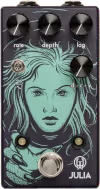
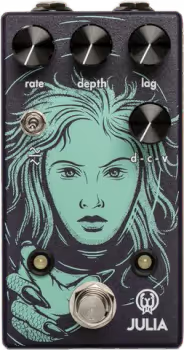
These two sit right next to each other in the Walrus modulation lineup and share the same blend-knob philosophy, so the comparison is natural. The Julia V2 is a chorus and vibrato: its D-C-V knob sweeps from dry through chorus to pure vibrato, and the core effect is shimmer and pitch movement. The Polychrome adds feedback to the circuit, which produces the frequency notching and comb-filtering that defines flanging. At low Feedback with the D-F-V dialed toward center, the Polychrome can approach chorus territory, but it won’t match the Julia’s warmth or lushness there. What the Polychrome buys you is the metallic intensity that comes with cranked Feedback, the parked-filter trick with Depth at zero, and the random LFO shape. If you primarily want chorus with an optional vibrato mode, the Julia is the direct answer. If you want the full flanger toolkit with vibrato as a bonus, that’s the Polychrome.
Players who want psychedelic, shoegaze, or space-rock textures will feel at home here immediately. The random waveform and parked filter mode make it useful for experimental and ambient work too. It’s also a strong fit if you want one pedal that covers flanger, vibrato, and a passable chorus-adjacent sound. The honest caveat: if you use a flanger occasionally for a classic jet-sweep effect and nothing more, most of the Polychrome’s depth goes unused. For everyone else, the flexibility is genuinely worth it.