Classic 108 Fuzz - MXR
Classic 108 Fuzz vs Timmy isn’t really a choice between two versions of the same thing. These are two different kinds of dirt from the same builder: one soft-clips and stays out of your amp’s way, the other clips hard enough to reshape the waveform into something close to square. The widget above plays both through the same loop, the same chain and the same room, which is the fairest way I know to hear what actually separates the two categories.
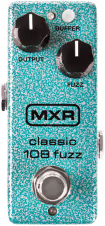
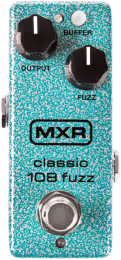
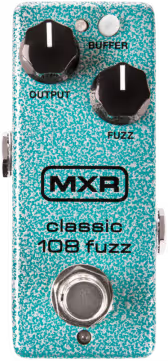
The Classic 108 fits a full Fuzz Face circuit into a mini enclosure, built around the BC108 silicon transistor that put the crunch in ’60s and ’70s fuzz. The panel is deliberately minimal: Output on the left, Fuzz on the right, a buffer toggle on the side, and that’s it.
Silicon makes it brighter and harder than a germanium Fuzz Face, with more edge and less warmth, and it has the practical advantage of staying consistent regardless of temperature. Fuzz runs from a fairly mild amp-like grind at the bottom up to a saturated wall at the top.
In the widget it sits near full tilt, Fuzz at 10 with Output at 8 and the buffer engaged, which is that round, dirty crunch with long sustain and a forward midrange. The buffer switch matters more than it sounds: a Fuzz Face circuit placed after a buffered pedal or a wah normally loses the pickup interaction it depends on, and flipping the buffer on makes the pedal chain-order agnostic. The full Classic 108 demo sweeps the Fuzz knob across its whole range.
 Tone quest ends here
  Buy now, brag later
  One More won't hurt
 Buy through these links and support Loopy Demos at no extra cost to you.
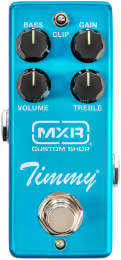
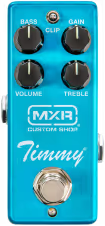
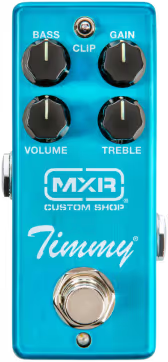
The Timmy is MXR’s production version of Paul Cochrane’s circuit, and it works on the opposite principle. The three-way Clip toggle sits at the top, with Bass and Volume on the left and Gain and Treble on the right.
The EQ is the thing to understand: Bass cuts the low end before the gain stage and Treble cuts the high end after it, and both are cut-only. Turning them up doesn’t add anything, it just removes less. That’s why it leaves your amp’s own voice alone rather than stamping a mid-hump onto it, and it’s also why it reveals a rig rather than flattering it. The Clip toggle changes the clipping character itself, between symmetrical and asymmetrical and between low and high headroom, so you can shift the saturation without touching a knob.
Here it runs Gain at 6.5 with Clip in position 2, the heavier-saturation position, and Bass trimmed to 4. That’s a medium-gain, open sound with the low end tightened rather than a fuzz. The full Timmy demo has sweeps for Gain, Bass, Treble and all three Clip positions.
 Shred responsibly Impulse buy here Cure your GAS!
 Buy through these links and support Loopy Demos at no extra cost to you.
Worth saying plainly: these do different jobs, and plenty of boards have both. Stacked, the Timmy makes a perfectly good clean-ish push into the fuzz.
Get the Classic 108 if you want the classic silicon fuzz voice, switched on and loud, without maintaining a vintage germanium pedal. It’s a two-knob, one-character box for classic rock, blues and psych, the mini footprint slots onto a packed board, and the buffer switch removes the usual placement headaches. If you need a fuzz that cleans up gracefully into overdrive or offers a sweepable tone control, this isn’t that pedal.
Get the Timmy if you already like your amp and want to add gain without rearranging your tone. The cut-only EQ gives you real control over what gets trimmed, the three Clip positions cover everything from a soft rhythm push to a heavier lead voice, and it stays organic across the full gain range. The honest caveat is that it won’t add warmth or body on its own, so if your base tone is thin it will tell you so.