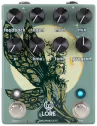
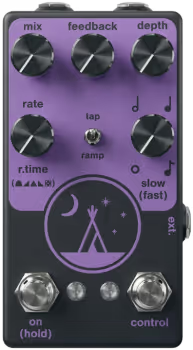
The Callisto MKII by Catalinbread is an analog chorus and vibrato for dream-pop and lo-fi. I like how this is a traditional, no-nonsense approach to chorus in a modern package: four interactive knobs, a BBD analog circuit, and enough range to go from subtle shimmer all the way to seasick vibrato without the pedal ever fighting you.
To spice up the chorus circuit, there is an additional feedback control that can push the Callisto into almost flanger territory. That way, you can dial in mellow, lush chorus sounds or some more psychedelic, funky settings. This is the type of pedal that you can just plug and play, find a setting you like and forget it. But since all the knobs are pretty interactive, there is a lot of subtlety to be discovered here.
Controls
The panel reads left to right across two rows. Top row: Rate on the left, Fdbk on the right. Bottom row: Mix on the left, Depth on the right.
Rate sets the LFO speed. Depth controls how wide the modulation swings. Mix is the dry/wet balance: noon sits at classic chorus, and turning it all the way clockwise gets you pure vibrato with no dry signal mixed in. Fdbk is the interesting one: it feeds a portion of the BBD output back into the circuit. At minimum you get the cleanest chorus sound; as you turn it up the repeating resonance pushes toward flanger-like clanging.
In the demo above I’ve set up sweeps for all four knobs, so you can hear what each one does to the same playing. The Rate, Mix, Depth and Feedback sweeps each isolate a single parameter while holding the others steady, which makes it easy to dial in where you want to land.
How It Sounds
The presets show the range. Spacey Chorus (rate 3, fdbk 8, mix 6, depth 6) keeps the rate slow and leans on the feedback for a swirling, slightly unhinged quality. Tender Chorus (rate 5, fdbk 3, mix 8, depth 3) is the bread-and-butter setting: moderate rate, low feedback, mix pushed up for a full but controlled shimmer. Wild Vibrato (rate 8, fdbk 8, mix 6, depth 6) cranks both rate and feedback at once for something woozy and unstable.
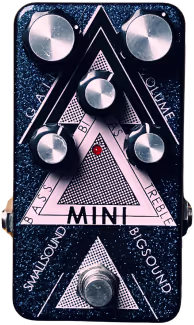
Boomy Feedback (rate 2, fdbk 10, mix 5, depth 2) is the flanger-adjacent edge case: minimal rate and depth with feedback maxed, turning the modulation into a slow resonant sweep. Chorus Drive adds the SS/BS Mini overdrive to show how the Callisto holds up on a driven signal.
Callisto vs Julia
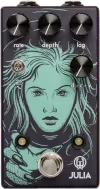
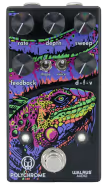
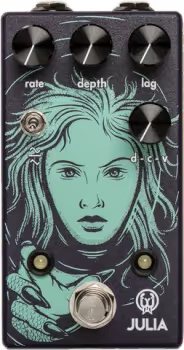
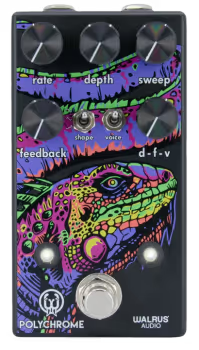
The natural comparison is the Walrus Audio Julia V2, the other analog chorus/vibrato on this site. Both pedals cover the full range from chorus to vibrato, and both use an analog circuit for warm, rounded modulation.
The Julia’s defining feature is the D-C-V knob, which blends continuously from dry through chorus to 100% wet vibrato, plus a Lag control that adjusts the center delay time and a waveform toggle between sine and triangle LFO shapes. The Callisto doesn’t have a waveform switch or a Lag control, but it has the Fdbk knob, which is not on the Julia at all. That feedback regeneration is what lets the Callisto push past conventional chorus into flanger-adjacent territory; the Julia can’t do that. The Callisto also reaches full vibrato by turning Mix fully clockwise rather than using a dedicated blend control.
If waveform selection and precise dry/wet blending are priorities, the Julia covers that ground well. If you want the feedback resonance and the drift into flanger territory on top of standard chorus/vibrato, the Callisto is the one to reach for.
Who It’s For
Dream-pop, lo-fi, shoegaze and ambient players are the obvious audience, but the Callisto works anywhere lush analog modulation sits right. It’s especially useful as a set-and-forget texture pedal: find a Spacey Chorus or Tender Chorus setting, tuck the mix back, and let the backing track breathe. The one honest caveat: there’s no waveform switch or Lag control, so if you want to sculpt LFO shape or center delay time, the Julia gives you more options.
Specs
Circuit: 100% analog BBD (bucket brigade device)
Controls: Rate, Fdbk (feedback), Mix (dry/wet, full clockwise = pure vibrato), Depth
Bypass: true bypass
Power: 9 V DC center-negative, 10 mA minimum
Input impedance: 500k, output impedance: 2k
Dimensions: 4.33″ x 2.36″ x 1.96″ (110mm x 60mm x 50mm)