Shallow Water - Fairfield Circuitry
Shallow Water vs Julia is a fair fight in one narrow sense: both are analog chorus and vibrato pedals with a wet/dry blend, and both go well past lush. How they get there has almost nothing in common. The widget above plays them through the same loop, the same chain and the same room at three settings, Lush, Wild and Special, so you can hear that before reading a word about it.
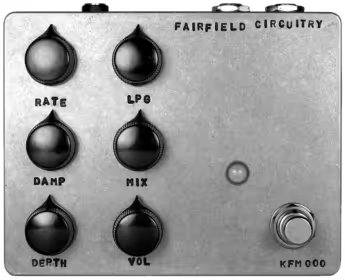
The Shallow Water is a bucket brigade chorus and vibrato with the LFO taken out. In its place Fairfield put what they call a K-field modulator, a pseudo-random generator, so the delay time wanders in random steps instead of sweeping predictably. That’s why it sounds unsettled even at conservative settings, and why no two passes through a riff modulate quite the same way.
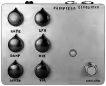
The panel reads Rate and LPG on top, Damp and Mix in the middle, Depth and Volume at the bottom. Rate sets how often those random pitch fluctuations happen, from rare to nervous in Fairfield’s own words. Damp shapes their slope: at minimum the steps are quick and sudden, wound up they slow until you need some dry signal in the Mix to read the movement as chorus at all. Depth sets intensity, Mix decides chorus or vibrato, Volume hits unity around noon.
LPG is the control with no equivalent on the Julia. It feeds the recovery filter’s envelope, so picking harder brightens the tone and adds a little bucket brigade noise, while a softer touch darkens it and chokes the sustain. In the Wild and Special settings above, Damp sits at zero with Rate high, which is where those steps get sharpest. There’s a lot more in the full Shallow Water demo.
 'Cause why not?
  Feeling pedalbored?
 Buy through these links and support Loopy Demos at no extra cost to you.
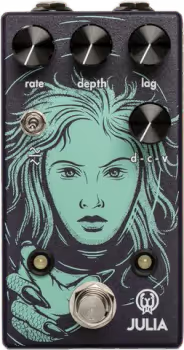
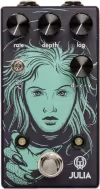
The Julia goes the other way: a fully analog chorus and vibrato built on a conventional LFO, with a toggle for sine or triangle waveforms. Rate sets the speed, Depth sets how wide the modulation swings, and the whole thing has the warm, slightly rounded quality that comes with an all-analog circuit.
Lag does the heavy lifting. It sets the center delay time the LFO modulates around, so turning it up shifts the effect from tight and transparent toward a thicker, more nauseating detune. Lush keeps Lag at 3 with a slow Rate; Special pushes it to 10 with Depth at 8, and the difference in thickness is easy to hear back to back.
D-C-V is the defining control. At minimum you get dry signal only, at noon equal dry and modulated signal in traditional chorus territory, and at maximum 100% wet for pure vibrato. Every shade between those poles is a knob position rather than a mode, which is what makes the Julia so easy to dial back to somewhere useful once you’ve gone too far. The full Julia V2 demo covers the Lag sweep and both waveforms.
 Snag one here Indulge a little Tone quest ends here
 Buy through these links and support Loopy Demos at no extra cost to you.
Get the Shallow Water if you’re chasing lo-fi, ambient or nostalgic texture rather than a chorus setting. The randomization means it never repeats itself exactly, and LPG hands your picking hand control over brightness and sustain, which is a lot of character for slow chords, ambient parts and anything meant to sound like old tape. If you need a modulation sound that’s identical every night, that’s a genuine limitation.
Get the Julia if you want the full chorus to vibrato range under control and repeatable. The D-C-V blend covers subtle shimmer, classic chorus and seasick wobble from one knob, it sits nicely under clean tones and single-coils, and the circuit is bass-compatible if you want slow, warm movement on low notes. It’s also the more predictable of the two on a board where the modulation has to land in the same place on every take.
A shootout of multiple modulation effects. Phasers, choruses, vibratos and flangers compared side-to-side. The Fairfield Circuitry Shallow Water, NativeAudio Midnight, ...
Shallow Water or Polychrome? The Shallow Water builds its whole circuit around random modulation and reacts to how hard you ...
Julia V2 or Polychrome? The Julia is Walrus Audio's analog chorus and vibrato, the Polychrome is their analog flanger with ...