Julia V2 - Walrus Audio
Julia vs Polychrome is a Walrus versus Walrus question, and the two pedals sit right next to each other in the same lineup. The Julia V2 is the analog chorus and vibrato, the Polychrome is the analog flanger, and both are built around the same blend-knob idea. The widget above plays them through the same loop, the same chain and the same room at three settings (Lush, Wild and Special), so you can hear where they overlap before reading a word about it.
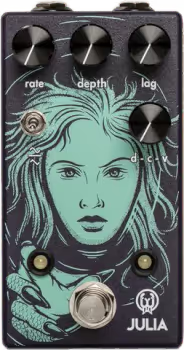
The Julia V2 is a fully analog chorus and vibrato. Its top row reads Rate, Depth and Lag. Rate sets the LFO speed, Depth controls how wide the modulation swings, and Lag is the interesting one: it sets the center delay time the LFO modulates around, so turning it up shifts the effect from tight and transparent toward a thicker, more nauseating detune.
Below Lag sits the D-C-V knob, the Julia’s defining feature. At minimum you get dry signal only, at noon equal dry and modulated signal (traditional chorus territory), and at maximum 100% wet for pure vibrato, with every blend in between available continuously. A toggle on the left picks between sine and triangle LFO shapes.
Being all-analog, the modulation has a warm, slightly rounded quality. In the widget, Lush keeps Rate, Depth and Lag low with the blend at 4, so you stay firmly on the chorus side. Special leaves the blend there but pushes Lag all the way to 10, which is where that thicker detune shows up. Wild moves the blend to 8, well into vibrato. There’s more on the Lag and waveform sweeps in the full Julia V2 demo.
 One More won't hurt
  Snag one here
  Treat yo' self
 Buy through these links and support Loopy Demos at no extra cost to you.
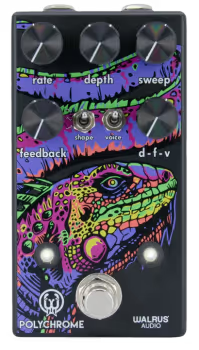
The Polychrome is an all-analog flanger built on a bucket brigade device. Rate, Depth and Sweep run across the top, where Sweep sets the center frequency of the flanger’s notch filter and shapes where in the frequency range the effect sits. Feedback sits below on the left, adding the regeneration that produces the metallic, jet-plane intensity, and the D-F-V knob on the right blends from fully dry through traditional flanger to pitch vibrato.
Two small toggles in the middle handle Shape (sine, triangle and random) and Voice (a traditional full-frequency flange or a complex notched flange with reduced low end). Feedback is the part the Julia has no equivalent for: it’s what turns pitch movement into frequency notching and comb filtering.
I purposefully set the Lush preset to tune the Polychrome toward a chorus sound, with Feedback at 2 and the D-F-V at 4, and back-to-back with the Julia I’m still not sure which chorus I like best. Wild cranks Feedback to 10 with the blend at 7. Special switches Shape to random, my favorite feature here: it makes everything sound more natural, as if the signal is going through some magic liquid. The full Polychrome demo covers the Sweep, Feedback and D-F-V sweeps.
 More pedals, more fun Tone quest ends here Upgrade your noise
 Buy through these links and support Loopy Demos at no extra cost to you.
Get the Julia if chorus and vibrato are what you actually reach for. It covers a touch of shimmer at one end, fully seasick vibrato at the other, and the continuous D-C-V blend means you never have to pick a mode. The analog circuit suits clean tones and single-coils, and the bass-compatible design makes it just as useful for slow, warm modulation on bass.
Get the Polychrome if you want the full flanger toolkit with vibrato as a bonus. Psychedelic, shoegaze and space-rock textures are its home turf, and the random waveform plus the parked-filter trick (Depth and Sweep at zero, Feedback cranked) push it into experimental and ambient work. If you only want a classic jet sweep now and then, much of that depth goes unused.

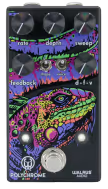
A shootout of multiple modulation effects. Phasers, choruses, vibratos and flangers compared side-to-side. The Fairfield Circuitry Shallow Water, NativeAudio Midnight, ...
Shallow Water or Julia V2? The Shallow Water swaps the LFO for a randomized modulator that never repeats itself, while ...
Shallow Water or Polychrome? The Shallow Water builds its whole circuit around random modulation and reacts to how hard you ...