The Unpleasant Surprise - Fairfield Circuitry
Unpleasant Surprise vs Fuzz Factory is a comparison between two pedals that want the same thing and go about it in completely different ways. Both gate, both sputter, and both will hand you a happy accident if you let them. The widget above plays them through the same loop, the same chain and the same room at two settings, Velcro Fuzz and Alternative Sound, so you can hear where they diverge before reading a word about it.
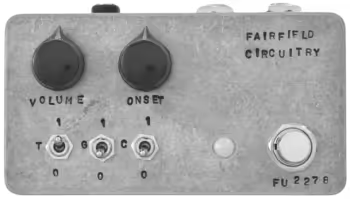
Fairfield calls this an experimental fuzz and gate, and the name is honest. The panel is just two knobs and three toggles: Volume for output, Onset for everything else, then T, G and C underneath.
Onset is the one that matters. Fairfield describe it as interstage gain that behaves like an inverse gate threshold, so turning it up adds saturation and sustain while turning it down drops into sputtery, ad-lib territory that borders on gating out completely. The toggles shape character rather than gain: T is an output treble cut, G shifts the amplifier’s bias between an open and a saturated voicing, and C is a feedforward stage that crushes the signal and is responsible for the harshest textures in the box.
You can hear both ends in the widget. Velcro Fuzz sets Onset low at 3 with C flipped in, which gives that choppy, stuttering decay rather than sustain. Alternative Sound maxes Onset at 10 with G and C engaged, and it goes dense and thick instead. To me it reads like hitting a recording console much too hard, in a good way, and it does the velcro thing a little more subtly than most. There’s a lot more of it in the full Unpleasant Surprise demo.
 More pedals, more fun
  Treat yo' self
 Buy through these links and support Loopy Demos at no extra cost to you.
The Fuzz Factory is built around two new old stock 1960s germanium transistors and an original ZVEX design rather than a copy of a vintage circuit, and it gives you five knobs that all argue with each other: Volume, Gate, Comp, Drive and Stab.
Gate is the signature. Clockwise it squelches hiss and buzz after a note decays; counterclockwise it opens into the gated chop the pedal is known for. Stab, short for Stability, is the wildcard, and ZVEX’s own manual warns that backing it off turns things soft and squishy. Open the Gate and pull Stab back together and the two fight over a decaying note, which is how you get shortwave warble and full self-oscillation.
The two widget settings sit either side of that. Velcro Fuzz keeps Gate at 6, squelched enough to stay tidy, with Drive maxed. Alternative Sound drops Gate to 2 and opens the whole thing up, which is where the artifacts start showing up between chord strokes. The full Fuzz Factory demo walks through all four sweeps.
 'Cause why not? Fuel your tone obsession
 Buy through these links and support Loopy Demos at no extra cost to you.
Get the Unpleasant Surprise if you want strange, ugly, garage-leaning fuzz without five interacting knobs to manage. Onset does the work of a gain control and a gate threshold at once, so you find the sound by ear in seconds rather than triangulating it. It’s the more contained kind of unpredictable, and the raw console-overload character is genuinely its own thing.
Get the Fuzz Factory if you want a pedal that fights back. It’s the one that squeals, self-oscillates and drifts into synth-like territory, and it rewards riding the knobs mid-song instead of setting them once. If you already like gated fuzz and want to push past it into something you can’t fully predict, this is the box that goes there.


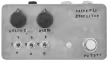
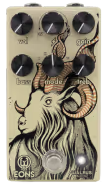
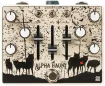
A shootout of 11 different velcro fuzz pedals. The Fairfield Circuitry Unpleasant Surprise, Walrus Audio Eons, Old Blood Noise Endeavors ...
Fuzz Bender or Fuzz Factory? Both reach velcro territory, but the Fuzz Bender gets there through an active EQ and ...
Two ZVEX fuzzes that behave nothing alike: the Fuzz Factory is germanium, gated and genuinely chaotic, the Mastotron is silicon ...