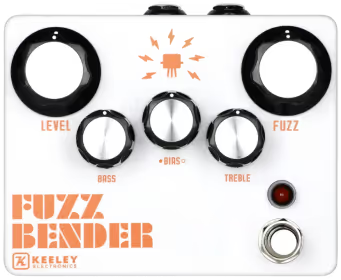
Fuzz Bender - Keeley Electronics
Fuzz Bender vs Fuzz Factory is really a question about how much unpredictability you actually want. Both are landmarks in gated fuzz and both reward dialing in, but one is built to be reproduced and the other is built to surprise you. The widget above plays them through the same loop, the same chain and the same room at two settings, Velcro Fuzz and Alternative Sound.
The Fuzz Bender is a three-transistor hybrid using both silicon and germanium stages in a Tone Bender topology, which is why it never lands as purely vintage-dark or purely modern-bright. Level and Fuzz sit up top, with Bass, Bias and Treble in a row underneath.
Bass and Treble are gyrator-based active EQ with plus or minus 20dB each, enough to scoop the low end completely or push it until things go loose and wooly. Bias adjusts the voltage reaching the transistors: low and the fuzz blooms smoothly, high and the circuit starves, gating notes into a sputtery decay.
The two widget settings sit at either end of that. Velcro Fuzz pins Bias at 10 with Bass at 7 for the starved, ripping tail. Alternative Sound backs Bias to 4 and pushes Treble to 8, which is rounder and brighter. In the shootout I noted the velcro part is a little more subtle here than on some of the others, and that’s fair: this is the spitty end of gated rather than the chaotic end. The full Fuzz Bender demo sweeps Bass, Bias, Treble and Fuzz.
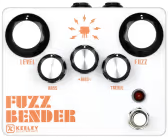
 Impulse buy here
  Fill that empty spot
  Feeling pedalbored?
 Buy through these links and support Loopy Demos at no extra cost to you.
The Fuzz Factory is an original ZVEX design built around two new old stock 1960s germanium transistors, and its five controls, Volume, Gate, Comp, Drive and Stab, interact in ways that aren’t remotely linear.
Gate squelches noise as you turn it clockwise and opens into gated chop as you turn it back. Comp adds attack rolled left, softens to the right, then pinches into a squashed voice near maxed. Stab is the wildcard: ZVEX say to leave it clockwise for a standard fuzz and warn that backing it off goes soft and squishy. Open the Gate and pull back Stab together and the pedal starts self-oscillating.
Velcro Fuzz in the widget keeps Gate at 6 and Drive maxed, tidy enough to behave. Alternative Sound drops Gate to 2 and lets it open up, and that’s where you get the artifacts when you mute between strokes. It’s probably the most singular-sounding pedal in the whole shootout. The full Fuzz Factory demo has sweeps for Gate, Comp, Drive and Stab.
 Treat yo' self Fill that empty spot
 Buy through these links and support Loopy Demos at no extra cost to you.
Get the Fuzz Bender if you want gated fuzz you can rely on. The EQ controls work independently and Bias sweeps a defined range instead of feeding back into everything else, so a setting you found at home still works at the gig. The active EQ also makes it a real option on bass, and at low Fuzz with Bias at zero it does a convincing cranked-amp overdrive, which is a lot of range for one box.
Get the Fuzz Factory if the unpredictability is the point. It squeals, gates and self-oscillates into territory nothing else here reaches, and it responds differently to different guitars and pickups, which is either the appeal or the dealbreaker. If you like tweaking a pedal mid-set and want the artifacts as part of the performance, this is the one that gives you them.

A shootout of 11 different velcro fuzz pedals. The Fairfield Circuitry Unpleasant Surprise, Walrus Audio Eons, Old Blood Noise Endeavors ...
Unpleasant Surprise or Fuzz Factory? Both reach gated, chaotic fuzz, but one gets there from two knobs and three toggles ...
Fuzz Bender or Alpha Haunt? Both are gated fuzzes with real EQ on board, but one is a hybrid Tone ...
Two ZVEX fuzzes that behave nothing alike: the Fuzz Factory is germanium, gated and genuinely chaotic, the Mastotron is silicon ...