Fuzz Bender - Keeley Electronics
Fuzz Bender vs Alpha Haunt is the comparison to have if you’ve decided you want a gated fuzz and you also want to be able to fit it into a rig. Both give you far more tone shaping than a classic two-knob fuzz, and they arrive at the velcro texture from opposite circuit traditions. The widget above plays them through the same loop, the same chain and the same room at two settings, Velcro Fuzz and Alternative Sound.
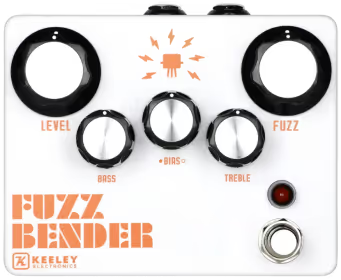
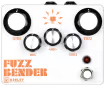
The Fuzz Bender is a three-transistor hybrid, running silicon and germanium stages together in a Tone Bender topology. Level and Fuzz sit in the top row, with Bass, Bias and Treble underneath.
Bass and Treble are gyrator-based active EQ with plus or minus 20dB of swing each, which is a genuinely large range: you can scoop the low end out entirely or push it until the fuzz goes loose and wooly. Bias is the interesting one, adjusting the voltage reaching the transistors and with it the feel of the attack. Low, and the fuzz blooms smoothly. High, and the circuit starves, gating notes into that velcro-ripping decay.
That’s exactly what separates the two widget settings. Velcro Fuzz runs Bias all the way at 10 with Bass at 7, starving the transistors for the spitty, sputtery tail. Alternative Sound pulls Bias back to 4 and pushes Treble to 8, which blooms and brightens instead. What I like about it is how the guitar melts into a full band mix rather than getting swallowed the way a Big Muff can. The full Fuzz Bender demo has sweeps for all four knobs.
 Snag one here
  One More won't hurt
  Upgrade your noise
 Buy through these links and support Loopy Demos at no extra cost to you.
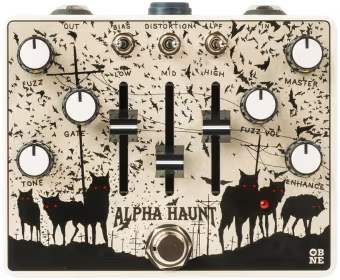
The Alpha Haunt is the expanded Haunt: a silicon high-gain gated fuzz with a 3-band EQ, a parallel Enhance boost and three extra toggles bolted on. Fuzz, Gate and Tone sit on the left, Bias, Distortion and LPF toggles across the top with Low, Mid and High sliders below, then Fuzz Vol, Master and Enhance on the right.
Gate is the most dramatic control on the board, running from wide open to hard gating. Enhance folds unprocessed signal in parallel with the fuzz, so you can add body without touching the fuzz voice at all. The Mid slider is the one I reach for most, since it dials in a midrange that actually cuts.
In the widget, Velcro Fuzz sets Gate at 7 with Fuzz at 8 and Mid at 7, which is where the compression on the attack shows up. Alternative Sound loosens Gate to 4, drops Fuzz to 5 and pushes High to 10 for something more open and buzzing. That ripping feel, as though the amp is about to implode, is very prominent here. More in the full Alpha Haunt demo.
 Fuel your tone obsession Tone quest ends here Impulse buy here
 Buy through these links and support Loopy Demos at no extra cost to you.
Get the Fuzz Bender if you want vintage Tone Bender character with modern control, and you want gated tones you can reproduce night to night. The Bias knob sweeps a defined range rather than feeding back into everything else, so it stays predictable, and the active EQ makes it genuinely useful on bass as well as guitar. It’s also the one that covers cranked-tweed overdrive territory at the low end of the Fuzz knob.
Get the Alpha Haunt if you want to sculpt a velcro fuzz precisely into an existing rig. The 3-band EQ plus Enhance gives you enough control to compensate for a bright amp or a dark one, and the gating stays satisfying wherever you set the fuzz controls. It suits stoner, psych, garage and noise rock, and it’s the better fit if you plan to stack it with what’s already on the board.

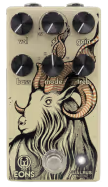
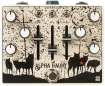
A shootout of 11 different velcro fuzz pedals. The Fairfield Circuitry Unpleasant Surprise, Walrus Audio Eons, Old Blood Noise Endeavors ...
Fuzz Bender or Fuzz Factory? Both reach velcro territory, but the Fuzz Bender gets there through an active EQ and ...