Colour Box V2 - JHS Pedals
Colour Box vs M81 is a comparison between two preamps rather than two overdrives, which changes what you’re actually choosing between. Both colour a bass signal and both can go direct, but one is a studio console in a box and the other is built to disappear into a board. The widget above plays them through the same bass loop, the same chain and the same room at two settings, Thump and Bite.
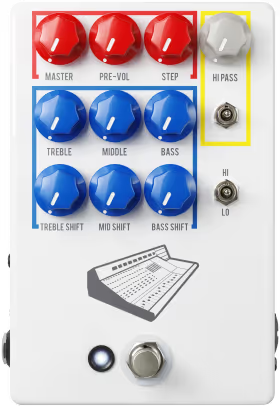
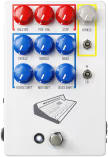
The Colour Box V2 recreates the Neve 1073 console preamp, with a genuine output transformer new in V2. The panel splits into two colour-coded rows: red for gain, with Master, Pre-Vol, a five-position Step rotary covering +18dB to +39dB, and Hi Pass; blue for EQ, with Treble, Middle and Bass each carrying a Shift knob underneath that moves the band’s center frequency rather than just its level.
That Shift arrangement is what makes it a genuine tone-shaping tool rather than a flavour box. Bass Shift alone reaches from 20Hz to 440Hz, which is a lot of control over where the weight of a bass sits. Step is the structural gain control, adding a fixed chunk at each position before Pre-Vol does anything.
Both widget settings keep Step at 3 and push Pre-Vol into the overdrive range, at 6.5 for Thump and 7 for Bite, with Bite lifting the Middle to 8 and shifting the bass band higher. For bass it works as a subtle colouring preamp and EQ, and it pushes into distortion with a preamp clipping character that’s genuinely its own. There’s a full guitar walkthrough in the Colour Box V2 demo.
 Buy now, brag later
  Treat yo' self
  One More won't hurt
 Buy through these links and support Loopy Demos at no extra cost to you.
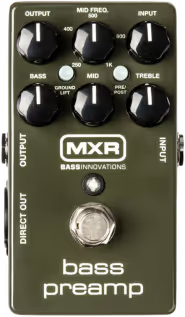
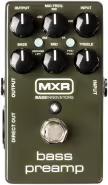
The M81 fits in a Phase 90-sized enclosure and covers preamp, DI and EQ duties at once. Top row: Output, Mid Freq, Input. Second row: Bass, Mid, Treble. Input drives the signal into the circuit, which is where the saturation comes from, and MXR’s Constant Headroom Technology is what keeps the clean tone tight even when you push it.
Mid Freq is the control that earns its keep, sweeping the midrange center from 250Hz to 1kHz. Paired with the Mid knob it becomes a parametric midrange shaper, which is how you get a more pronounced bite or carve space in a crowded mix. There’s also a PRE/POST pushbutton deciding whether the Direct Out carries the signal before or after the EQ.
Thump runs Input at 7 with the EQ fairly flat at 7 across the board. Bite pushes Input to 10 and Mid to 10, which is where the saturation makes itself felt, adding grit and presence without becoming an overdrive pedal. That’s the honest summary of this box: a tone sweetener with a very good EQ section. The full M81 demo sweeps all four EQ controls.
 Buy now, brag later Impulse buy here Feeling pedalbored?
 Buy through these links and support Loopy Demos at no extra cost to you.
Get the Colour Box V2 if you want one box that colours, shapes and distorts, and you record as much as you play. The parametric EQ, the combo XLR input with phantom power and the gain range running from clean DI up to fuzz make it a studio tool you can gig with rather than a pedal that moonlights as a preamp. The trade is complexity: ten knobs and two toggles take real time before they become intuitive.
Get the M81 if you want your bass to sound better at every stage without thinking about it. It weighs almost nothing, runs on a 9V battery, and between the sweepable mid, the DI out and the PRE/POST switch it covers a gig on its own. It won’t take you into distortion territory, and there’s no compressor or cab sim in there, but as a permanent board resident that never gets in the way it’s hard to argue with.
A shootout of the best bass overdrive pedals. I love using guitar pedals on bass and experimenting with finding the ...
SFT vs Colour Box for bass: the Catalinbread SFT is a JFET Ampeg preamp with four knobs, the JHS Colour ...
Blumes or Colour Box V2 for bass? The Blumes is a bass-voiced overdrive with three clipping modes, the Colour Box ...