The Colour Box V2 by JHS Pedals is a recreation of the famous Neve 1073 recording console preamp in pedal format. It adds that vintage studio character you can hear on records by Led Zeppelin, Spoon, Pink Floyd, and David Bowie, and it does it with a genuine output transformer (new in V2) and a parametric EQ that gives you real control over where the colour lands.
What keeps it interesting beyond the one-trick-pony concern is just how wide the gain range is. You can run it clean as a studio-style DI, push it into grinding overdrive, or slam the preamp hard enough to get genuine fuzz. It also handles vocals, bass, acoustic guitar, and keys. It’s more of a studio tool you can gig with than a guitar pedal that moonlights as a preamp.
Controls
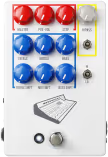
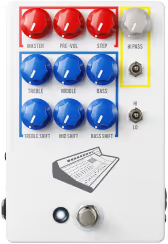
The panel divides into two colour-coded rows. The red knobs handle gain: Master (output level), Pre-Vol (drive between the two internal stages), Step (a five-position rotary from +18dB to +39dB of preamp gain), and Hi Pass (filter cutoff frequency). The blue knobs handle EQ: Treble, Middle, and Bass, each with a corresponding Shift knob below that moves the band’s center frequency rather than just cutting the level. Two toggles to the right engage the high-pass filter and select the Hi/Lo headroom mode.
In the demo above I’ve set up sweeps for the Pre-Vol (Gain Range), the Step rotary (Steps), the Hi Pass toggle (Hi Pass On/Off), the Hi/Lo switch (Hi/Lo), and all three Shift knobs (Treble Shift, Mid Shift, Bass Shift), so you can hear what each one actually does to the same signal.
How It Sounds
The Step rotary is the structural gain control: each position adds a fixed chunk of gain, so the five steps cover a wide range before you even touch Pre-Vol. The Reactive Fuzz preset (pre at 8.5, step at 5) shows how hard you can push the circuit when both controls are up. The Juicy Drive preset (pre at 6, step at 4) sits in the overdrive range. Clean Sheen (pre at 5, step at 2) keeps things shimmery and controlled with the treble lifted.
The EQ is genuinely parametric in the sense that matters most: the Shift knobs let you move the frequency center rather than just adjusting level at a fixed point. The Treble Shift sweeps from 2kHz up to 30kHz, the Mid Shift covers 150Hz to 2.4kHz, and the Bass Shift reaches from 20Hz to 440Hz. The Low Mid Focus preset stacks the Middle and Bass both at 10 with the bass shift at its upper range, which shows how much low-end weight the EQ can add. The high-pass filter, adjustable between 160Hz and 650Hz, is there to clean that up when needed.
The combo XLR/quarter-inch input means you can plug in a condenser mic, run 48V phantom power through it, and record directly to your interface. That’s an unusual capability for a pedalboard unit, and it makes the Look Ma, No Amp! preset make sense: no amp in the signal chain, just the Colour Box V2 and a plugin for monitoring.
Colour Box V2 vs 424 Gain Stage
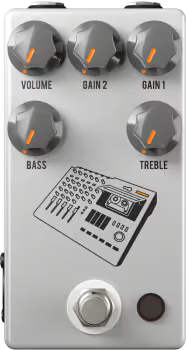
Both JHS preamps put studio gear on your pedalboard, but from opposite ends of the studio. The Colour Box V2 is a Neve 1073 console preamp: precise and flexible, with a parametric EQ, an output transformer, and gain that runs from clean boost to fuzz on deliberate terms. The 424 Gain Stage recreates the Tascam 424 Portastudio preamp with its original op-amps intact, built entirely for lo-fi elastic saturation and cassette compression. Both have a balanced XLR output for direct recording; the Colour Box adds phantom power and a pad switch for microphone work, which makes it the more versatile DI of the two.
Studio-minded guitarists and producers who want one box that handles guitar, bass, vocals, and keys as a DI will get the most from it. The parametric EQ makes it genuinely useful for shaping a direct-recorded signal rather than just coloring it. At high Step and Pre-Vol settings it covers overdrive and fuzz territory, so it can function as the only gain stage in a direct rig. The honest caveat is complexity: ten knobs and two toggles means there’s real learning time before it becomes intuitive, and the 9V-only power requirement rules out high-voltage analog rigs.
Specs
Circuit: Neve 1073 console preamp recreation with output transformer (V2)
Input: combination XLR/quarter-inch (selectable); XLR supports 48V phantom power and includes a -20dB pad switch
Controls: Master, Pre-Vol, Step (5-position rotary, +18dB to +39dB), Hi Pass, Treble (±15dB), Middle (±10dB), Bass (±15dB), Treble Shift (2kHz to 30kHz), Mid Shift (150Hz to 2.4kHz), Bass Shift (20Hz to 440Hz), Hi Pass toggle (160Hz to 650Hz, 2nd-order), Hi/Lo switch
Bypass: silent switching
Power: 9V DC negative center, standard pedal supply only
Dimensions: 5.7″ × 3.75″ × 1.85″
Signal Chain
Fidelity Guitars Stellarosa Lite II with Lollar Firebird pickups (neck pickup)