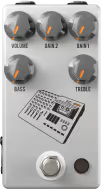
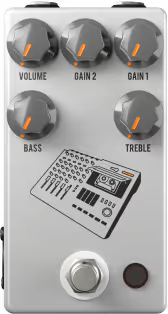
The 424 Gain Stage nails that rubbery, lo-fi Portastudio magic in a compact pedal format. JHS recreated the preamp circuit from a vintage Tascam 424 MKI multitrack cassette recorder, complete with the original UPC4570 and NJM4565 op-amps that give it that distinctive gooey character. It’s essentially Mk.gee’s signature sound: that elastic, dreamy texture you hear when someone runs their guitar straight into a Portastudio instead of an amp.
Controls
The panel runs left to right across two rows. Top row: Volume (master output level), Gain 2 (the channel stage), and Gain 1 (the trim, or input preamplification). Bottom row: Bass and Treble, both cut/boost controls. There’s also a ground lift dip switch on the side for the XLR output, useful when you’re getting hum from different ground paths.
The dual gain structure is where things get interesting. Gain 1 and Gain 2 work together with Volume to dial in everything from a clean boost to saturated lo-fi fuzz territory. The bass and treble controls are surprisingly powerful for shaping the character: you can go from warm and rounded to bright and cutting. In the demo above I’ve set up sweeps for Gain 2, Gain 1, Bass, and Treble, so you can hear exactly what each one does independently.
How It Sounds
Light picking through the lower gain settings gives you those compressed, tape-saturated cleans that add warmth and presence without smearing the transients. Push both gain stages up and it crosses into saturated, smashed-out territory. Clean Volume keeps both gain knobs at noon for a unity-ish transparent boost. DI Grit raises Gain 1 to 8.5 and Gain 2 to 7.5 for that furred-up cassette edge. Maxed Out drives both gain stages and the whole EQ to 10 for full blown-out fuzz. Garage Recording drops the bass to 1 and treble to 3 for a darker, more lo-fi texture at moderate saturation. The Fuzz + Amp and Overdrive + Amp presets show how it pairs with the Benson Chimera, and the 80s Mixtape and Physchedelic Stack presets show how it anchors a bigger effects chain rather than just coloring the front of it.
424 Gain Stage vs Cassette Preamp
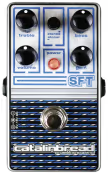
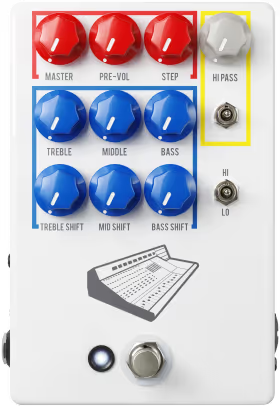
The Color Audio Cassette Preamp covers a lot of the same ground: both pedals chase lo-fi vintage cassette character using op-amps sourced from actual period hardware. The differences come down to circuit pedigree and feature set. The 424 is modeled specifically on the Tascam 424 MKI using that machine’s original UPC4570 and NJM4565 chips; the Color Audio uses NJM2068 and M5218 from Tascam-style cassette decks more broadly. The Color Audio adds dedicated high-pass and low-pass filters for extra tone-sculpting range, and it runs 9 to 18V for more headroom options. The 424 tops out at 9V (JHS warns against exceeding it) but gives you a balanced XLR DI output and dual simultaneous outputs, which makes it a quicker grab for direct recording without an interface preamp. Both live in the same lo-fi cassette lane; your choice comes down to whether you want more voltage flexibility and filter control, or a dedicated XLR out and the specific Portastudio circuit.
Who It’s For
If you’re chasing Mac DeMarco, Steve Lacy, or modern indie and dream pop textures, this pedal delivers the source material directly. It’s not trying to be a traditional overdrive: it’s a genre tool for adding unmistakable vintage cassette character that sits perfectly where pristine clarity would be the wrong call. I find myself using both outputs simultaneously: the quarter-inch into an amp for monitoring and the XLR straight to the interface for that authentic bedroom pop sound. The bypass is buffered but transparent, so it won’t mess with your signal chain when off.
If your sound lives in lo-fi, dreamy, or psych territory, the 424 earns its place. If you need clean studio color rather than cassette grit, look at something in the console preamp family instead.
Specs
Circuit: historically accurate recreation of the Tascam 424 MKI input stage using original UPC4570 and NJM4565 op-amps
Controls: Volume, Gain 1 (trim), Gain 2 (channel), Bass (cut/boost), Treble (cut/boost)
Ground lift dip switch for XLR output
Outputs: 1/4″ instrument out and balanced XLR DI out (both simultaneous)
Bypass: buffered, with silent soft-touch switching
Power: 9V DC center negative, 50mA (do not exceed 9V)
Dimensions: 2.6″ x 4.8″ x 1.6″
Inspiration from the recording of Spoon’s Gimme Fiction
Signal Chain
Fidelity Guitars Stellarosa with Mojo Lipstick Pickups (both pickups in series)