SFT - Catalinbread
SFT vs Colour Box is a fair fight for bass players, even though the two boxes come from completely different places: one is an Ampeg amp in a box, the other is a recording console channel with a stomp switch on it. The widget above plays both through the same bass loop, the same chain and the same room at two settings, Thump and Bite, so you can hear where they separate before you read a word about it.
The SFT is Catalinbread’s JFET take on an Ampeg preamp, and if you’re talking distorted rock bass tone you can’t really get around a classic SVT. That’s the target here.
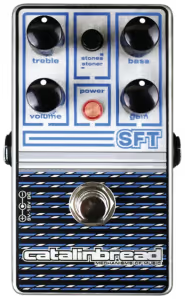
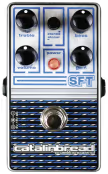
The panel is small. Treble and Bass sit in the top row with the mode pushbutton between them, Volume and Gain flank the status LED in the middle row, and the bypass stomp is at the bottom. Treble and Bass are active Baxandall controls, so noon is flat, above it each knob boosts and below it each one cuts. On bass that distinction earns its keep: you’re not limited to rolling things off, you can put low end back after the gain stage rather than hunting for what survived it. The pushbutton toggles stones (green LED) and stoner (red LED), which shifts the available gain range instead of just raising a ceiling.
Both widget settings use that. Thump runs stones mode with Gain at 3 and Treble at 8, while Bite flips to stoner with Gain at 2 and a little more Bass. With the EQ at noon the circuit has a lower-mid push of its own, and it responds to how hard you dig in.
There’s a lot more detail, recorded on guitar, in the full SFT demo.
 Your tone deserves this
  Tone quest ends here
  Feeling pedalbored?
 Buy through these links and support Loopy Demos at no extra cost to you.
The Colour Box V2 recreates the Neve 1073 console preamp, and V2 does it with a genuine output transformer. It’s more of a studio tool you can gig with than a guitar pedal that moonlights as a preamp, which is exactly why so many bass players end up with one.
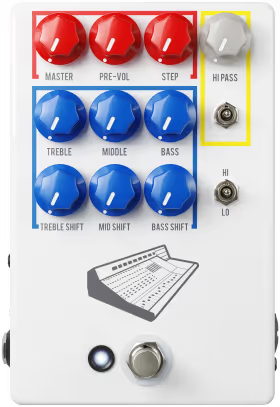
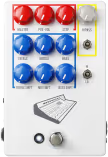
The panel splits by colour. Red handles gain: Master for output, Pre-Vol for drive between the two internal stages, Step (a five-position rotary from +18dB to +39dB of preamp gain), and Hi Pass for the filter frequency. Blue handles EQ: Treble, Middle and Bass, each with a Shift knob below it that moves the band’s centre frequency rather than its level. Bass Shift alone reaches from 20Hz to 440Hz, which covers the whole fundamental range of a bass and then some. Two toggles engage the high-pass filter and pick the Hi/Lo headroom mode.
Both settings in the widget sit at Step 3 with Pre-Vol above 6, so what you’re hearing is preamp clipping rather than diodes. Bite pushes the Middle to 8, adds bass and flips the Hi/Lo toggle. Push the two gain controls further and the circuit gets into genuine fuzz, as the full Colour Box V2 demo shows.
 Fill that empty spot One More won't hurt More pedals, more fun
 Buy through these links and support Loopy Demos at no extra cost to you.
Get the SFT if you want driven Ampeg rock bass and want to get there fast. Four knobs and a mode button is the entire interface, the active Treble and Bass let you add back whatever the gain stage takes away, and it runs on anything from 9 to 18V at 4mA, so it slots into a board that already carries high voltage. It’s the simpler box for a live rig where grit should be one stomp away.
Get the Colour Box if you record. The combination XLR/quarter-inch input takes 48V phantom power and has a -20dB pad, the EQ shifts frequency centres instead of just levels, and the gain range runs from clean DI all the way to fuzz. The honest trade: ten knobs and two toggles need real learning time, it accepts 9V only, and at 5.7″ × 3.75″ it asks for serious board space.
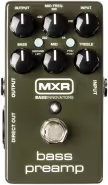
A shootout of the best bass overdrive pedals. I love using guitar pedals on bass and experimenting with finding the ...
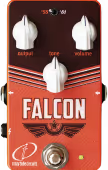
Catalinbread SFT vs Crazy Tube Circuits Falcon: the SFT is an Ampeg voice with an actively sculpting Baxandall EQ and ...
SFT or Blumes for bass? The SFT is an Ampeg-voiced amp-in-a-box with an active Baxandall EQ, the Blumes is a ...
Blumes or Colour Box V2 for bass? The Blumes is a bass-voiced overdrive with three clipping modes, the Colour Box ...
Colour Box V2 or M81 for bass? One is a Neve console preamp that goes from clean DI to genuine ...