SFT - Catalinbread
SFT vs Blumes is an odd pairing on paper: one is a JFET amp-in-a-box built for guitar that bass players kept borrowing, the other is the first pedal EarthQuaker ever designed specifically for bass. On a four-string they end up competing for the same slot. The widget above plays both through the same loop, the same chain and the same room at two settings, Thump and Bite, so you can hear where they part ways.
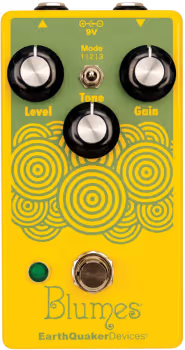
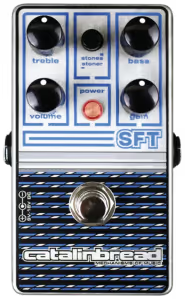
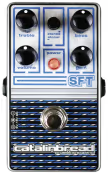
The SFT is a JFET circuit chasing an Ampeg, and if you’re after distorted rock bass tone, the classic SVT is hard to get around. The panel puts Treble and Bass in the top row with the mode pushbutton between them, then Volume and Gain flanking the status LED, and the bypass stomp at the bottom.
Those EQ knobs are the reason it adapts so well. They’re active Baxandall controls: noon is flat, above noon each one boosts, below noon it cuts. That gives you real range to fit the pedal to your bass and the rest of the chain rather than just trimming treble off a fixed voice. The mode pushbutton toggles stones (green LED) and stoner (red), which shifts the available headroom instead of just raising a ceiling.
In this recording the SFT never needs much drive. Thump sits in stones mode with Gain at 3 and Treble at 8, Bite flips to stoner with Gain at 2 and a touch more Bass. Worth knowing before you buy: that mode button isn’t footswitchable. My full SFT demo is a guitar recording and walks the Gain, Bass and Treble sweeps in both modes.
 Cure your GAS!
  Buy now, brag later
  Upgrade your noise
 Buy through these links and support Loopy Demos at no extra cost to you.
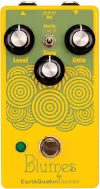
The Blumes is a modified Plumes, EQD’s hot-rodded screamer, given double the gain and a deeper bass response so the low end survives where the guitar original thins out. There’s no clean blend, because the circuit is voiced correctly for bass from the ground up. On these riffs it adds midrange definition while leaving plenty of fatness and girth underneath.
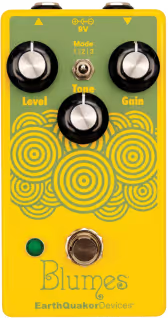
Level sits upper left, Gain upper right, Tone in the center below them, and the three-position Mode toggle sits between Level and Gain. Tone sweeps from darker and bass-forward on the left to brighter treble emphasis on the right. Mode is where the character changes outright: position 1 is symmetrical LED clipping, the crunchiest and most compressed; position 2 pulls the diodes out for a wide-open op-amp boost; position 3 is asymmetrical silicon, looser and warmer with a fuzzier edge.
The two settings here use two different modes. Thump runs mode 1 with Gain at 4 and Tone just past noon, Bite jumps to mode 2 with Gain at 7 and Tone at 8, which is the genuinely aggressive end of this pedal, closer to a full distortion voice. The full Blumes demo is bass throughout and sweeps Mode, Tone and Gain.
 Tone quest ends here Cure your GAS! Feeling pedalbored? Your tone deserves this
 Buy through these links and support Loopy Demos at no extra cost to you.
Get the SFT if you’re chasing SVT-style rock bass grind and want tone controls that actively sculpt rather than filter. The Baxandall stack makes it a flexible always-on foundation across different basses and DI chains, and because it was built for guitar it earns its board space twice if you track both. Just plan around the pushbutton, since changing modes mid-set means bending down.
Get the Blumes if you want a drive that was voiced for bass in the first place and never asks you to blend clean signal back in to keep the low end. The three clipping modes cover snappy compressed grind through to a loose, warmer fuzz edge, and mode 2 below noon doubles as a clean boost. If a clean blend control is non-negotiable for you, this isn’t the one.
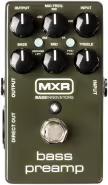
A shootout of the best bass overdrive pedals. I love using guitar pedals on bass and experimenting with finding the ...
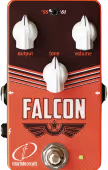
Catalinbread SFT vs Crazy Tube Circuits Falcon: the SFT is an Ampeg voice with an actively sculpting Baxandall EQ and ...
SFT vs Colour Box for bass: the Catalinbread SFT is a JFET Ampeg preamp with four knobs, the JHS Colour ...
Blumes or Colour Box V2 for bass? The Blumes is a bass-voiced overdrive with three clipping modes, the Colour Box ...