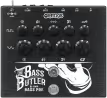
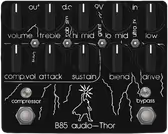
The Thor packs two independent circuits into one Hammond 1590BB enclosure: a bass preamp with drive, a four-band EQ and a cabinet-sim DI on one side, and a fully separate compressor with its own footswitch and LED on the other. B85 Audio builds it in the Czech Republic and developed it together with Ján Firek, bassist for the progressive metal band Melodius Deite.
Because the two circuits are wired independently, you’re not locked into one combination. Run the compressor on its own through a clean tone, add the preamp and its drive when the choruses hit, or switch both off. It’s built to cover preamp, drive, compression and DI duties from a single board slot.
Controls
The top row of five knobs is the preamp’s EQ: Volume, then Treble (18 kHz), Hi Mid (2.3 kHz), Lo Mid (300 Hz) and Low (100 Hz), giving a genuine four-band EQ plus master level. The second row holds Comp Vol, Attack and Sustain for the compressor, plus Blend and Drive for the preamp. B85 notes that Volume and Drive are interdependent, so moving Drive changes your output level too, and Volume needs a touch afterwards. Blend sets the balance between the clean and the distorted signal rather than committing you fully to saturation.
Between the two knob rows sit four small toggles. Freq belongs to the compressor, and B85 describes it as letting the compressor double as a frequency booster. Cab Sim engages an Ampeg SVT 610 cabinet emulation on the DI output. Grunt and Ultra Hi shape the drive circuit’s saturation independently at each end of the spectrum, Grunt down low and Ultra Hi up top. Freq, Grunt and Ultra Hi each have three positions; Cab Sim has two.
Two footswitches run the show: the right stomp bypasses the whole preamp and drive circuit, with a blue status LED, while the left stomp switches the compressor in and out on its own and lights a separate red LED. Since the two are decoupled, you can leave the compressor running through a bypassed preamp, or vice versa.
In the demo above there are four full presets, plus sweeps for all four EQ bands, Blend, Drive, Attack, Sustain and each of the four toggles. The four presets start with both circuits engaged, so the two footswitches give you every combination: preamp and compressor together, either one alone, or neither.
How It Sounds
Clean Foundation is built around the low end: Low at 8, Lo Mid at 7, Hi Mid at 6 and Treble pulled back to 4. Drive sits at 5 with Blend at 4, the lowest Blend of the four, and the compressor runs its gentlest Sustain of the set at 4, with Attack at 6.
Solid Grunt keeps the EQ flat, all four bands at 5, with Drive at 5 and Blend at 6. The compressor gets a medium Sustain of 5 and Attack at 7, which on the Thor means a slower onset that lets more of the pick attack through before it clamps down. Grunt is up, Ultra Hi and Freq sit in the middle.
Fat DI Distortion is where the drive circuit starts to take over: Drive at 8, Blend at 7, and an EQ that leans on the low mids, with Lo Mid at 6 and the other three bands at 4. It’s the only preset with Cab Sim flipped down, and Grunt, Ultra Hi and Freq all sit down as well. Sustain climbs to 7, with Comp Vol at 6.5.
Rock Bass pushes furthest: Drive at 9 and Blend at 8, the most of either in the set, and every EQ band above noon, with Treble and Lo Mid at 7, Low at 6.5 and Hi Mid at 6. Attack drops to 4, the fastest of the four presets, while Sustain stays at 7. Grunt and Freq go up, Ultra Hi down.
On any of the four, kick the compressor out to hear what it was doing, or bypass the preamp and let the compressor work on the bass alone. The Attack, Sustain and Freq sweeps also start with the compressor engaged, and Freq steps through all three positions, which is the quickest way to hear what B85 means by the frequency booster mode. The EQ, Blend, Drive, Cab Sim, Grunt and Ultra Hi sweeps run the preamp on its own.
Thor vs MXR Bass Preamp
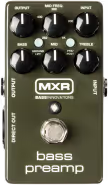
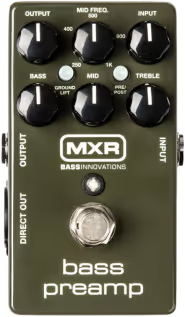
The MXR M81 Bass Preamp is the closest comparison on this site: both give you a multi-band EQ, some saturation and a DI out in a single box. The M81 keeps things focused, with a three-band EQ, a sweepable mid and a PRE/POST switch on the Direct Out, and no compressor at all. Its saturation comes from pushing the Input knob rather than a dedicated drive with a Blend. The Thor adds a fourth EQ band, a full drive circuit, an independent compressor with its own footswitch and LED, and a built-in Ampeg cab-sim toggle on the DI. That makes the Thor the more complete single-box rig, at the cost of a bigger panel to learn; the M81 stays simpler if a preamp and DI are all you need, leaving compression to a separate pedal like the MXR M87 Bass Compressor.
Who It’s For
The Thor suits bass players who want their preamp, drive, compression and DI handled by one pedal rather than three, especially in progressive, metal or modern rock contexts, given that B85 developed it with a progressive metal bassist. The independent compressor circuit is the standout: you’re not choosing between drive and dynamics control, since either can run without the other. If you only need a straightforward EQ and DI, the M81 is the easier pedal to learn; if you already run a dedicated compressor and just want drive and EQ, that’s also worth weighing against the Thor’s combined footprint.
Specs
Two independent circuits: preamp/drive and compressor, each on its own footswitch, true bypass
Preamp controls: Volume, Treble (18 kHz), Hi Mid (2.3 kHz), Lo Mid (300 Hz), Low (100 Hz), Blend, Drive
Preamp toggles: Grunt (low saturation) and Ultra Hi (high saturation)
Compressor controls: Comp Vol, Attack, Sustain, plus a Freq toggle that lets the compressor act as a frequency booster
DI: TRS Direct Out with Cab Sim toggle (Ampeg SVT 610 emulation) and ground lift with red indicator LED
Power: 9V DC, center-negative, 50 mA max (adapter not included)
Enclosure: Hammond 1590BB, approximately 94 x 124 x 51 mm
Made in the Czech Republic, developed with Ján Firek (Melodius Deite)