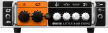
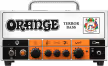
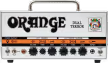
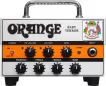
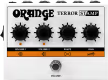
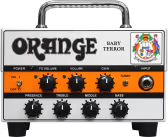
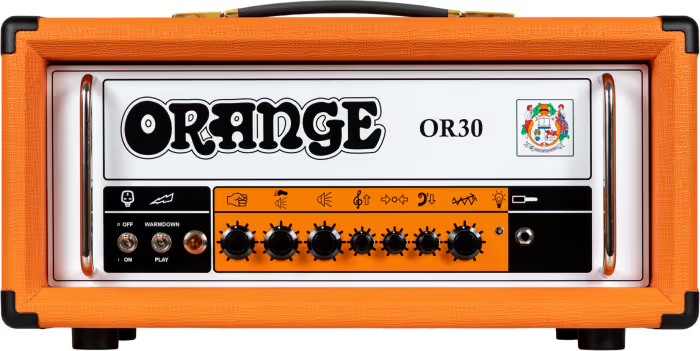
Orange shrinks their British grind into something that genuinely fits in a gig bag pocket. The Baby Terror is a 20-watt head in the familiar lunchbox shape, 1.5 kg on the scale, running off an external 15V supply. One thing worth clearing up straight away, because the Terror name has meant a valve preamp on every other head in the line: there’s no valve in here. The front end is a single-ended, Class A JFET circuit, the same solid-state approach Orange uses across the Baby 100 series, voiced to mimic the progressive clipping and warmth of a tube preamp rather than to be one.
What surprises me is how complete the panel is for the footprint. Gain, two volumes with the second footswitchable, a full three-band EQ plus a dedicated presence, and the Tubby switch. Round the back sit a series effects loop, a balanced XLR line out with ground lift, and both 8 and 16 ohm speaker outputs, so it’ll drive anything from a small 1x12 up to a 4x12.
Controls
The top row reads left to right: the power toggle, FS Vol, the power LED, Vol, Gain, then the Tubby switch out at the far right. The bottom row is the EQ stack: Presence, Treble, Middle, Bass.
Vol sets your main level and Gain decides how hard the JFET front end clips. FS Vol is a second output level you jump to with a footswitch, so it moves your volume without touching the gain structure or the EQ; Orange pitches it as a lead boost, which means parking it above Vol. Fair warning, it sits at zero in every preset in the demo above, so that boost isn’t something you’ll hear here.
Tubby is a low-end contour rather than a bass boost. Engaged, it injects a thicker, rounder bottom end, and it earns its keep with the gain rolled back, where clean and crunch settings can otherwise sound a bit lean. I’ve set up sweeps for Gain, Presence, Treble, Middle and Bass, plus a Tubby toggle sweep, so you can hear what each control does to the same riff instead of taking my word for it. Crunchy Platform is the only main preset that flips Tubby to the other position.
How It Sounds
The five main presets cover most of the ground. British Clean is the low-gain end: Gain at 3, Vol pushed to 7.5, Bass at 8 and Treble at 7 for a bright, open voice with the bottom end filled in. Crunchy Platform pulls the Middle back to 3 and keeps Gain at 5, which is the setting I’d use with drive pedals in front. Fat Gain is the classic Orange stance, Gain at 7 with Middle and Presence both at 7 and the Treble backed off to 4.
At the top, Chugging Scoop and Scorching Mids both max Gain and Presence at 10, and the Middle knob does the separating: down at 2 with the Treble up for the scooped, palm-muted version, up at 10 with the Treble at 3 for the mid-forward honk. That pair is the best argument for the four-knob EQ on a head this size. The Presence control has real authority too, warm and rounded when rolled back, cutting and aggressive wound up, which the Presence sweep runs through from 0 to 10 at Gain 7.
Baby Terror vs Terror Stamp
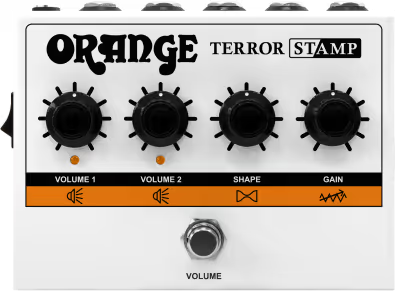
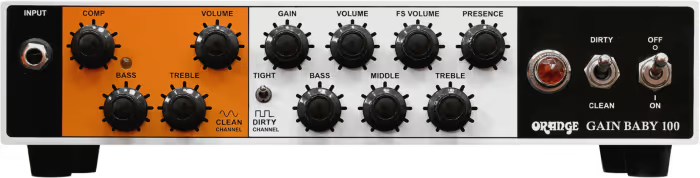
The Terror Stamp is the obvious cross-shop: also 20 watts, also Orange, also with two footswitchable volumes. The split is the front end. The Terror Stamp has a genuine 12AX7 driving its preamp with a solid-state power section behind it, and a single Shape knob for all its EQ, in a pedalboard-format enclosure with a CabSim headphone output. The Baby Terror is solid-state throughout, and spends its extra size on a proper Presence, Treble, Middle, Bass stack, a series loop and a balanced XLR with ground lift. Tube response and a pedalboard slot: Terror Stamp. Detailed EQ, a real head format and a recording-ready DI: Baby Terror. If you like the JFET voicing but need serious stage volume and two channels, the Gain Baby 100 runs the same single-ended JFET preamp topology into a Class A/B 100-watt power stage.
Who It’s For
Anyone who wants Orange character without the weight, and who does most of their listening through a DAW or a small cab. The XLR out with ground lift makes it a straightforward recording head, the loop keeps delays and reverbs out of the preamp, and 20 watts through an efficient cab is enough for rehearsal and small rooms. The gain range genuinely reaches modern territory, as the Chugging Scoop preset shows.
The honest caveats: there’s no reverb, no second channel, no headphone or cab-sim output, and no power scaling. And it’s solid-state, so if you’re the kind of player who rides the guitar volume knob expecting valve sag and bloom to meet you halfway, a Dark Terror 15 or Rocker 15 Terror will feel more interactive. What you trade that for is a head you can carry with one finger.
Specs
Circuit: single-ended Class A JFET preamp, solid-state power section