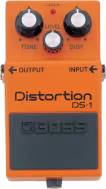
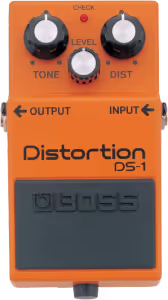
Introduced in 1978, the BOSS DS-1 is the longest-running distortion pedal in continuous production and the top-selling BOSS compact ever. It’s not particularly hip right now, which is exactly the point: the design has stayed functionally unchanged for nearly 50 years because it works.
My first pedal was actually a DS-2. I was deep into Red Hot Chili Peppers and John Frusciante at the time, and I remember it sounding harsh and crappy. In hindsight, that was probably the tiny Roland Cube, not the pedal. Coming back to the DS-1 with fresh ears and a better rig, I have to admit: it’s actually a pretty great sounding pedal.
Controls
Three knobs, left to right: Tone, Level, Dist. That’s the whole layout, and it’s been that way since Gerald Ford was president. The Tone knob shapes the character of the distortion through a tilting EQ, pulling back the mids toward a Big Muff-like scoop as you turn it up. The Level knob sets your output volume. Worth knowing: on some DS-1 units (mine included) you have to push Level well past noon just to hit unity gain. The Dist knob sweeps from almost-clean grit at zero to full grinding distortion at ten.
In the demo above I’ve set up sweeps for both the Dist knob and the Tone knob, so you can hear the full range of each one.
How It Sounds
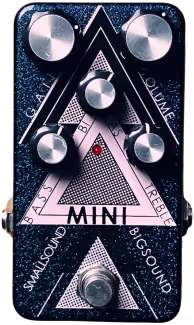
My favorite way to run it is stacked: DS-1 first in the chain at low Dist, then a low-gain drive after it. The Perfect Combo preset does exactly this, pairing the DS-1 (Dist at 2, Tone at 5, Level at 8) with the SS/BS Mini behind it. It gets you a punchy, fat distortion that’s perfect for catchy riffs, hooks and power chords, with the Mini tightening everything up.
For a standalone sound, the Rippin Distortion preset (Dist at 7, Tone at 4, Level at 8) shows what the pedal does on its own at higher gain. There’s real grind and sustain on tap here. I can’t say I hate it with the gain dimed either.
The Tone knob is worth spending time with. It shares the same tilting mid-scoop character as a Big Muff’s tone stack, which means it can go from surprisingly midful and present to scooped and wide. The DS-1’s two-stage circuit, combining a transistor and op-amp gain stage, gives it a low-frequency fullness that keeps it from sounding thin even at higher gain settings.
DS-1 vs ProCo Vintage RAT 1987
The ProCo Vintage RAT 1987 is the other classic orange-box distortion and the most natural cross-shop. Both old designs have stayed in the market because they landed on a tone players keep coming back to.
The RAT’s Filter control works the opposite way to the DS-1’s Tone knob: clockwise cuts highs rather than scooping mids, so you can go from bright and cutting to dark and compressed in a single sweep. The DS-1 stays punchier and more forward in the mids by default. The RAT leans into a compressed, chewy feel. Both pedals stack well with a low-gain overdrive. The choice comes down to whether you want mid-forward punch or creamier compression.
Who It’s For
This is a great first distortion for players who haven’t found their sound yet, and a useful tool for players who have. Kurt Cobain used one. Steve Vai used one from 1999 onward. The low gain end is genuinely usable and stacks well with almost any overdrive. If you want a modern, high-gain, tightly compressed distortion, look elsewhere. But if you want a versatile, loud, punchy box that works across classic rock, grunge, alt-rock and anything in between, a DS-1 on the used market is hard to beat.
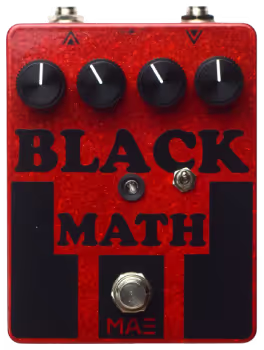
The tone stack’s mid-scoop also makes it a better companion to low-gain drives than a lot of distortion pedals. Running the MAE Black Math low and stacking it is a surprisingly close cousin to the Perfect Combo preset here.
Specs
Circuit: two-stage transistor and op-amp design; unchanged since 1978
Controls: Tone, Level, Dist
Power: 9 V DC (battery or PSA adaptor), 10 mA current draw
Dimensions: 73 x 129 x 59 mm; weight 360 g including battery
Battery life approximately 50 hours (carbon) or 80 hours (alkaline)
Signal Chain
Epiphone SG Special with Lollar Firebird pickups (both pickups)